Categories
Travel

Living Even, Murren to Grindelwald, via the Gorge

Day 4

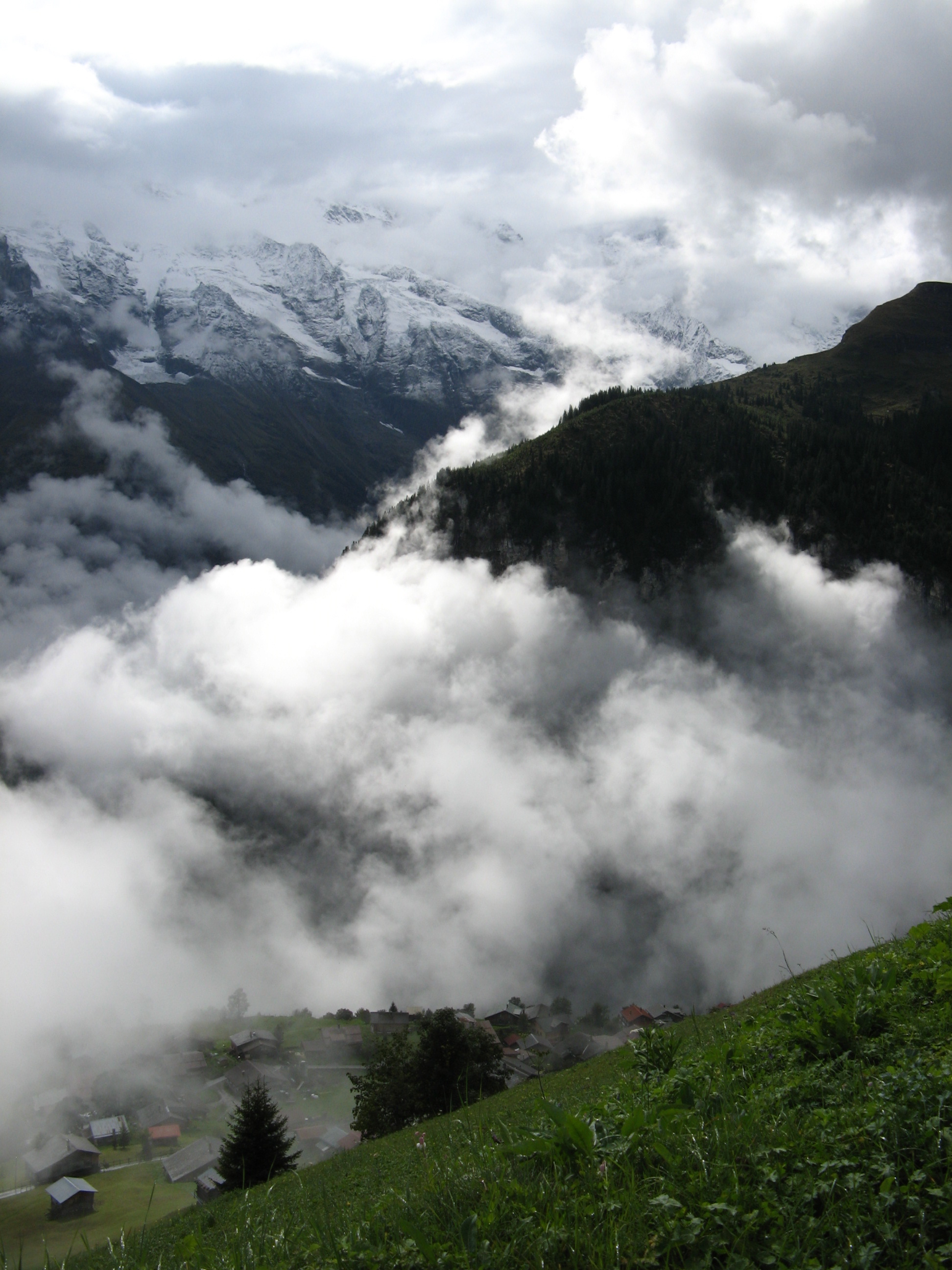
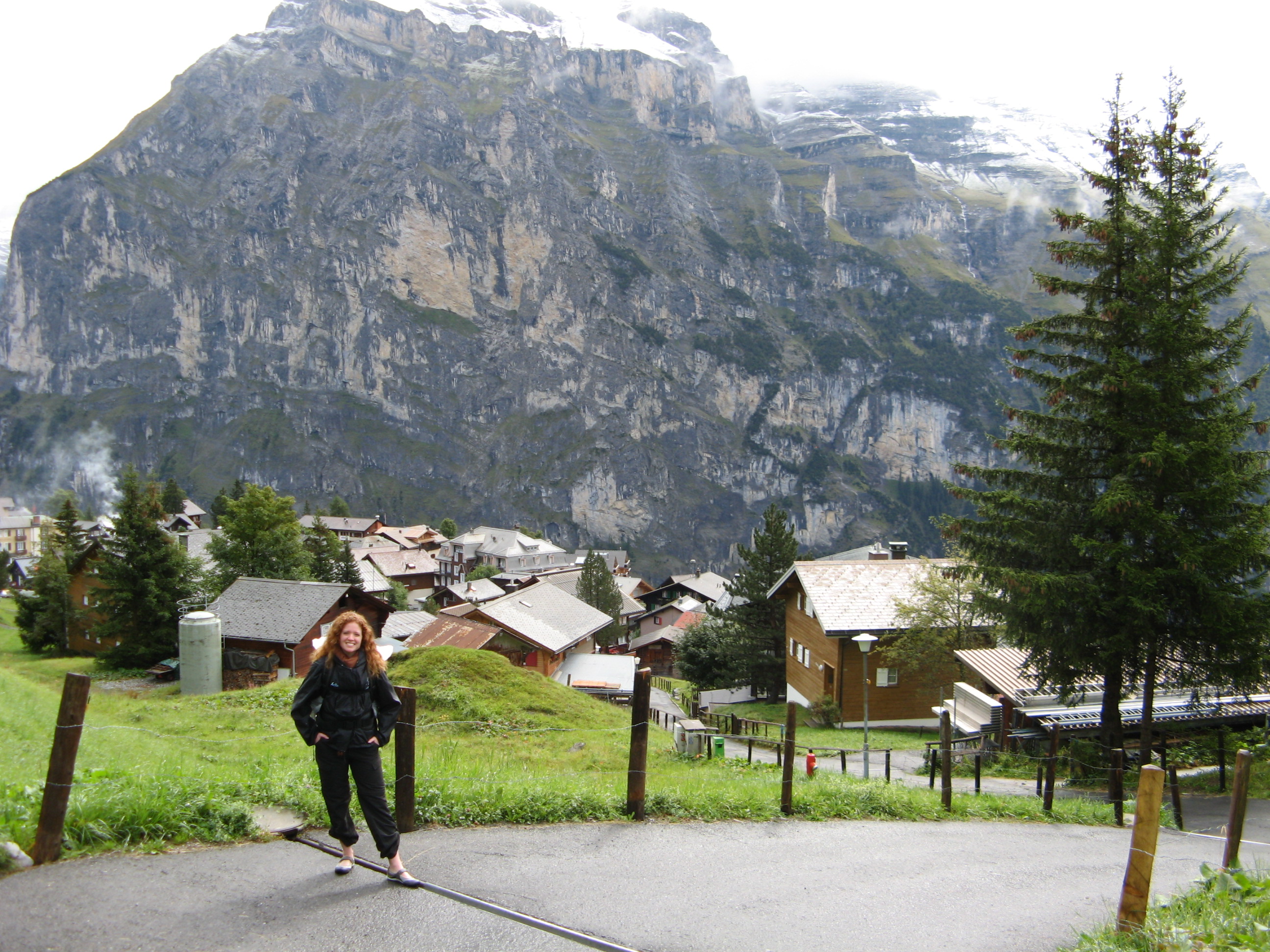
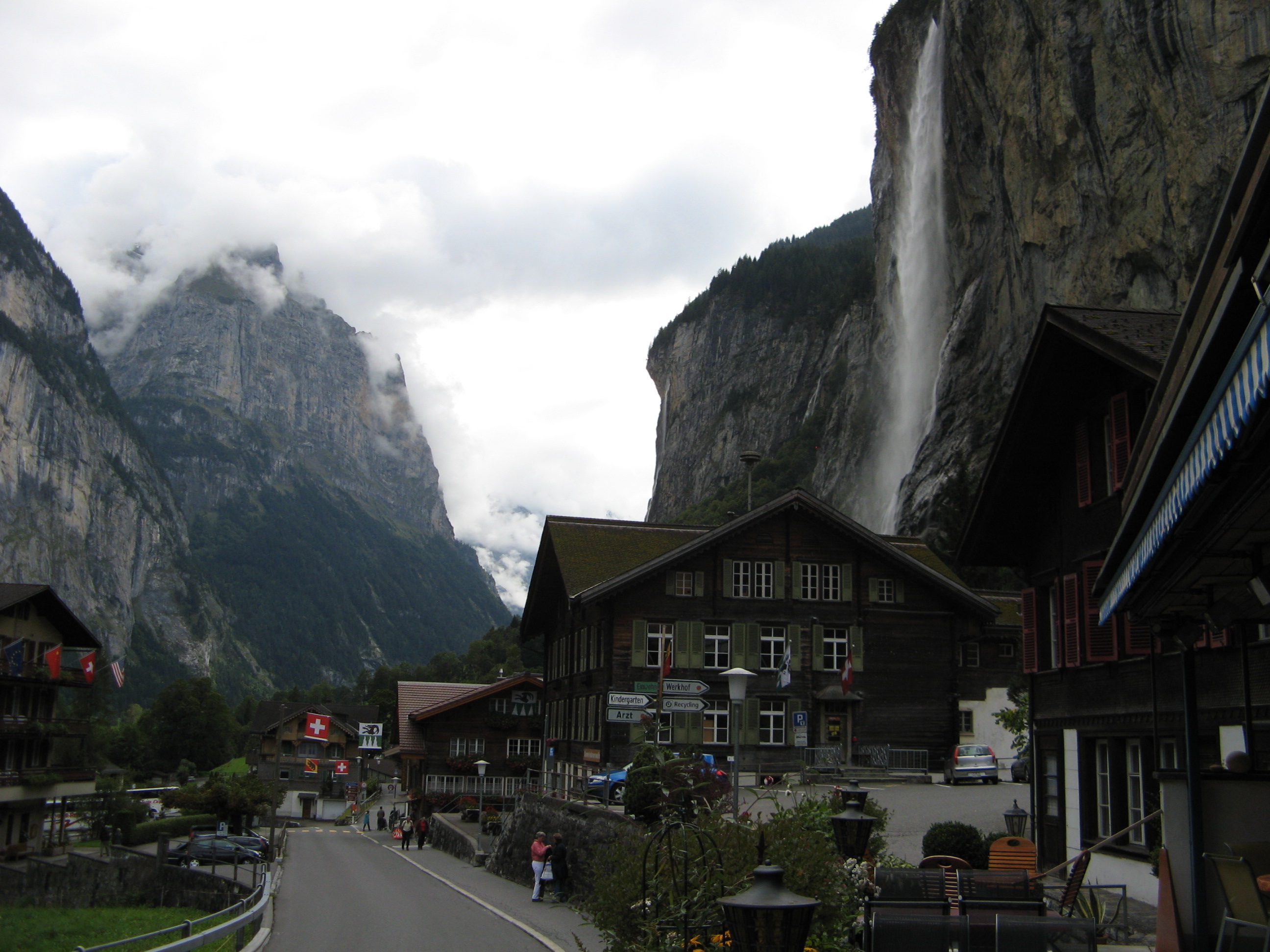
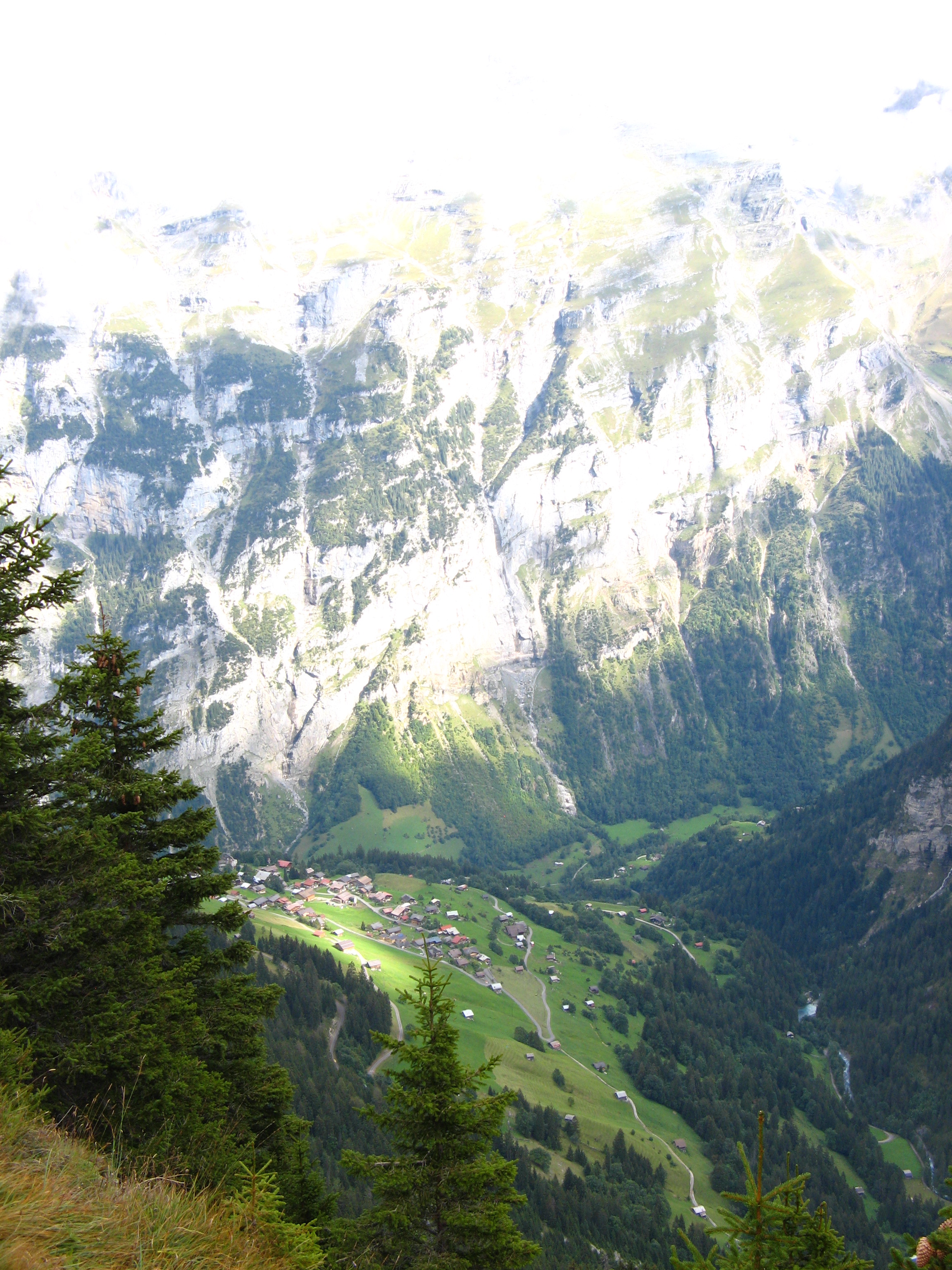
We woke up to slick streets in Murren. The fog had not lifted but from our huge breakfast window we were able to see the perennial waterfalls come from the mountains across the gorge.

Breakfast was in a tall white room, still in the school-house hotel of Hotel Regina. We had buffet style cheese, oatmeal and yogurt. Coffee was served in a silver canteen by someone who spoke to us only in German. We wrote post cards and read maps and decided to walk to Gimmewald to take a lift down into the Gorge.  The southern end of the gorge ending in the foothills of the Alps, the northern ending in the low lands of Interlaken.

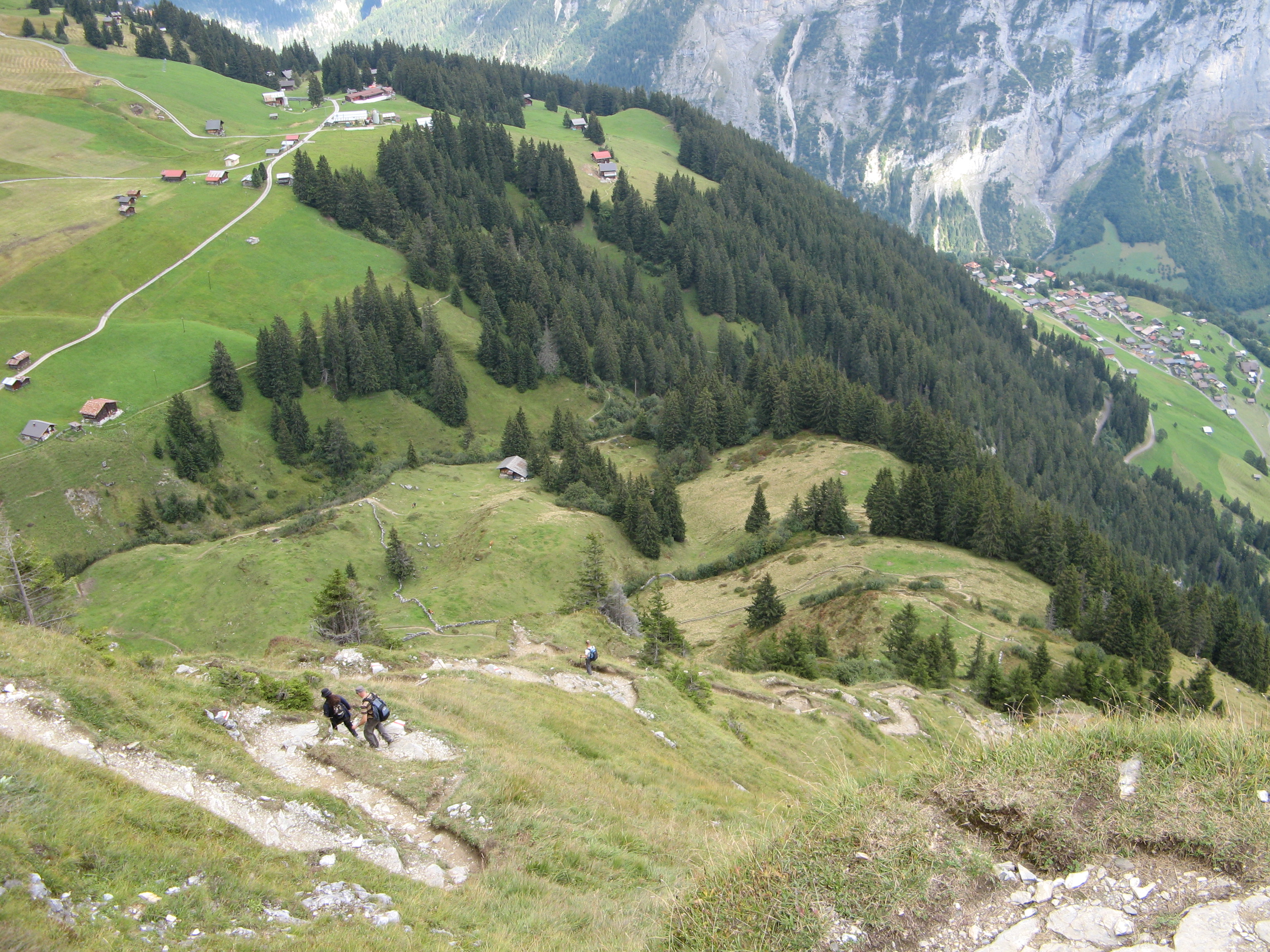
We walked to the higher levels of Murren before leaving. We were looking for a good overview of the town. We walked down flattened grass and muddy trails into the forest with slick roots and dense trees. There were many 5″ thick slugs in the native grass, and as we entered the dark Alpine forest we had to guess our way to Gimmewald. We found the city by chance as the clouds parted for just a minute to give us a glimpse. We followed our senses and met a Japanese couple just as we were coming into that town to find the lift down.  We ended up spending half our day with To-Ke-Ko and her husband.

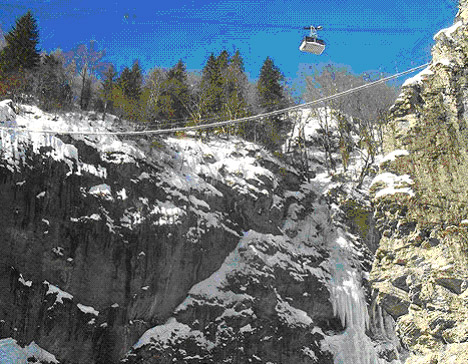
We weren’t expecting the lift to be so breath-taking. When Phil and I boarded the 20 person gondola we stepped to the front of the car. We noticed once we were moving that the cable seemed to fall off directly over the hill, and when our ride approached the edge of the cliff we both had to step back in amazement.  Once we were surefooted again, we took a few pictures as we came down into the gorge.  It was an unexpected, amazing ride. Thankfully we didn’t try to go near the cliff on foot at all. We weren’t prepared to do any scaling!  A few swinging foot bridges of wooden planks hung over the gaping crevices. I can’t imagine ever ever wanting to attempt those!

I took these photos from the Travel Blythe Clan because they really captured the reality of falling over the cliff of Gimmewald into the gorge.

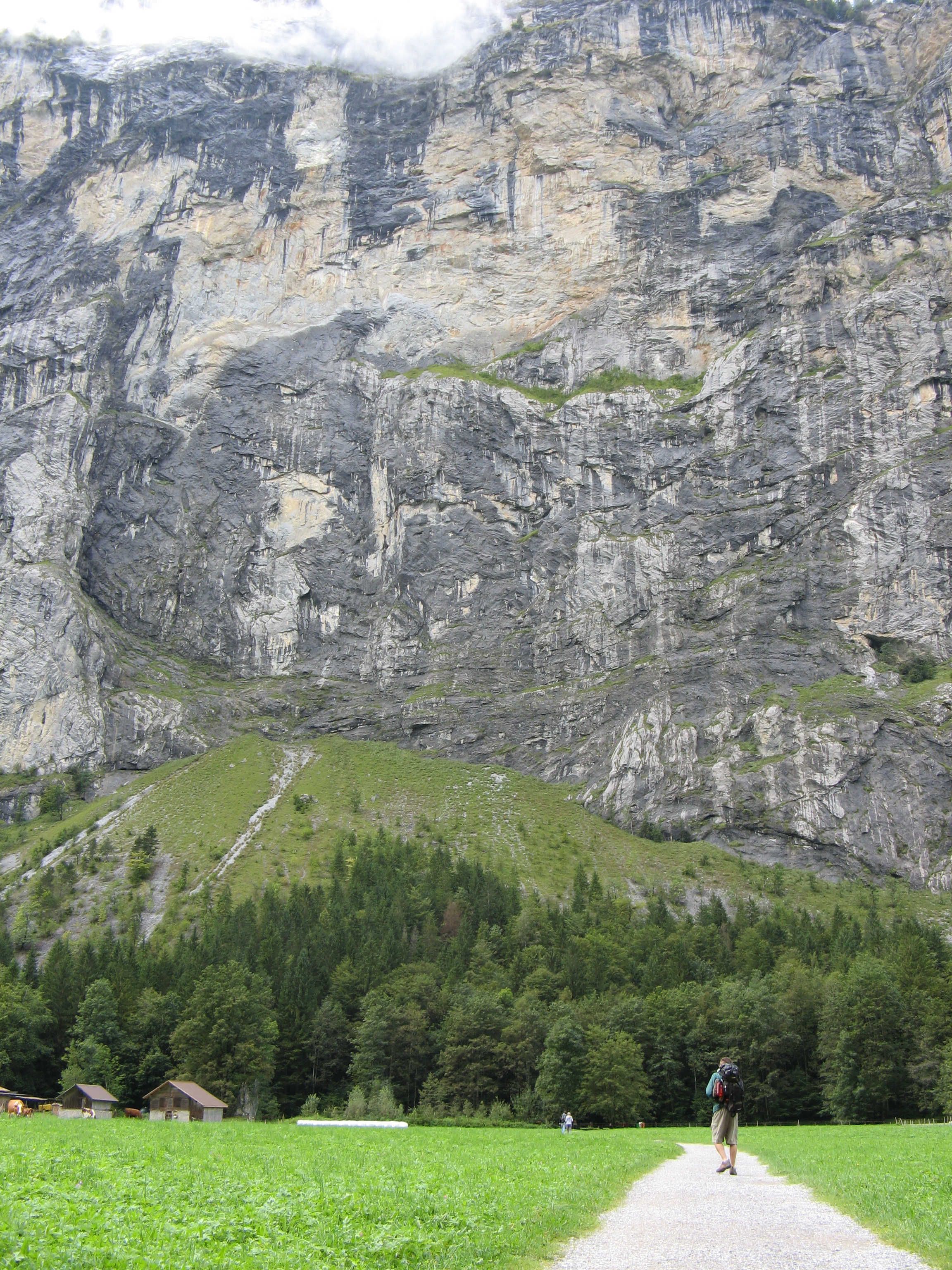
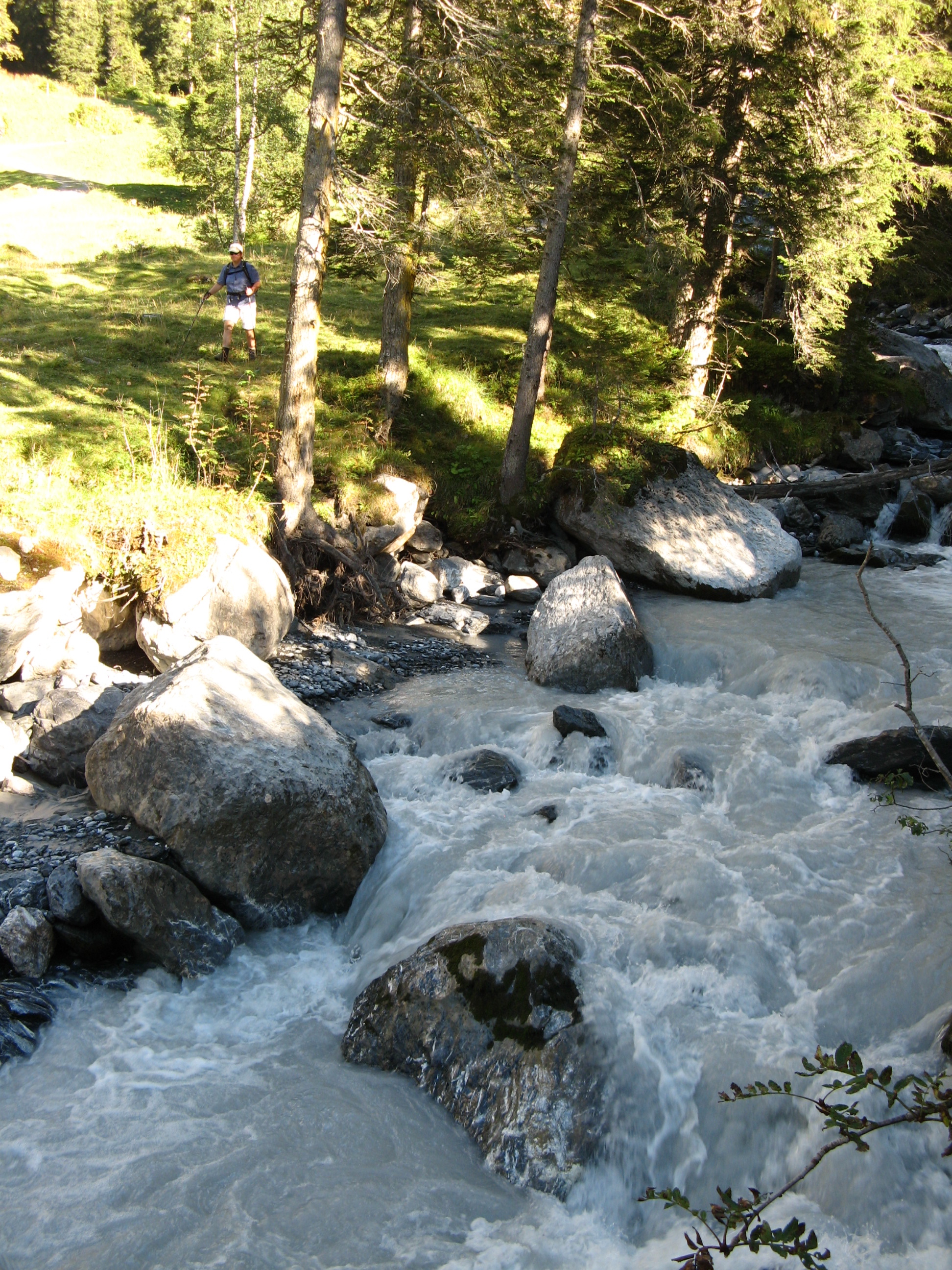
We began to tour the gorge after toppling into it with our friends. We walk and let the 1000 meter sides contain us. We are trying to find Trummelbach Falls. The waterfalls should be strong today because of the rains. Tokeko talks to me of the flowers she has visited in Russia over July 4th. She has gone to see them in the mountains, and as we walk along a grey mountain stream she picks flowers that are growing to tell me about them. We talked of her daughter’s children, and her son’s. We talked about family and ‘being close.’ She picked a Japanese Lantern and told me of what they tasted like when she was a child.

Later that night I would be served one with my dinner, as if by coincidence. Phil, in the mean time, held a conversation with her husband who we each had to piece together. He talked and Phil described the conversation as questioning the celebration of success. China had adopted the United States mentality of work, consumption, and money. Japan was following China. What about living even? Taking care of your own measure.  Summiting your own peaks -tending your own garden?

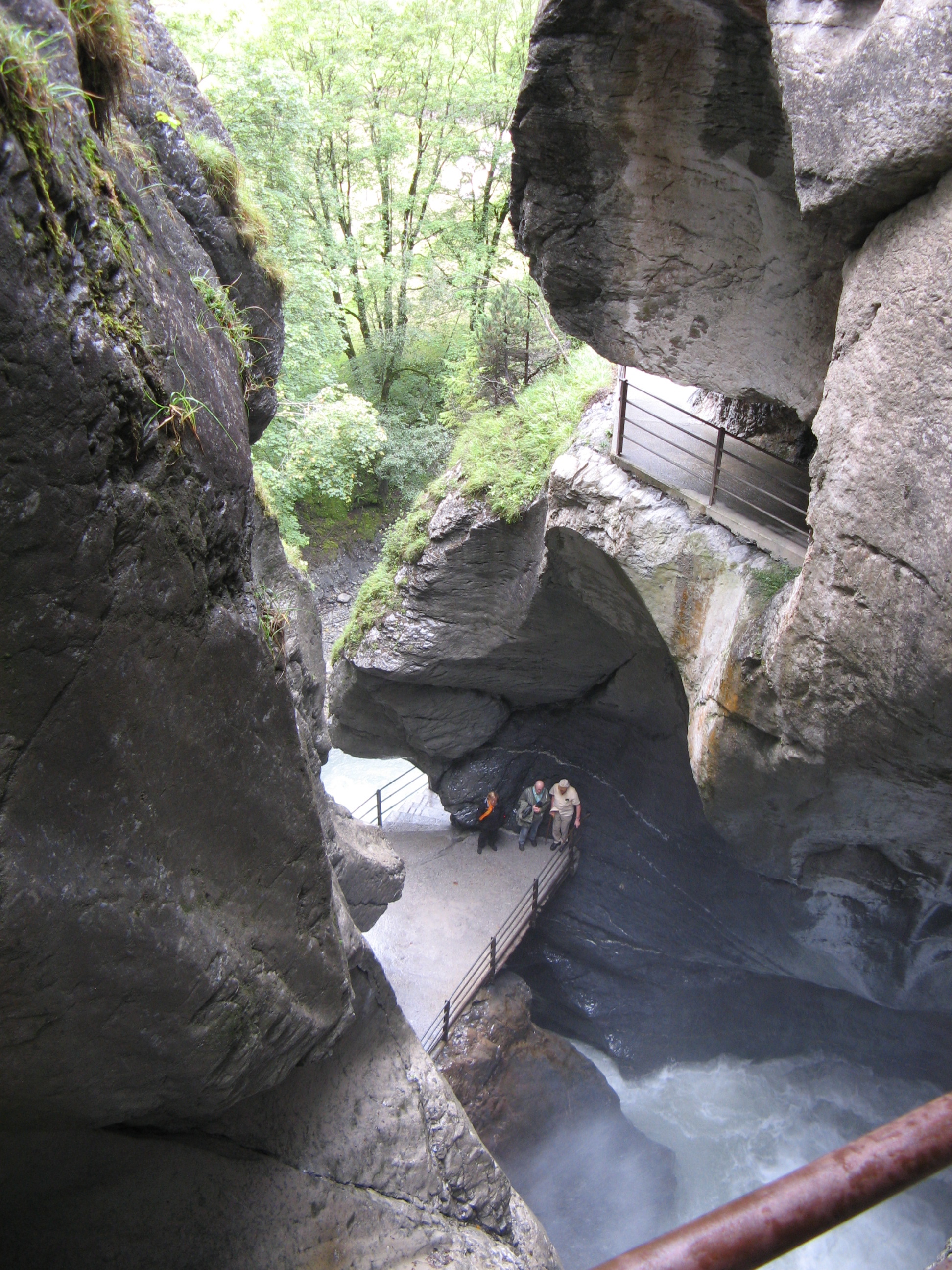
We lost our friends as we began to climb the rocky stairs of Trummelbach Falls. We put on our rain gear and enjoyed talking over the pounding water. The falls have carved themselves into the gorge side, and a trail now leads us into the rock to find the waterfall.  It is a rock house waterfall -pounding nature.Slick steps lead us up, down and through the waters way of crashing. We shared the orange Tokeko had given us as a gift when she learned we were on our honeymoon. We ate nuts and berries that we had packed from the prior day’s hike.

I wrote: We walk and the 1000 meter sides contain us, let the waterfalls crash. We just walk -all of our belongings here -with one another. So free, and full and ready to take in and take time.

.

.

.

.

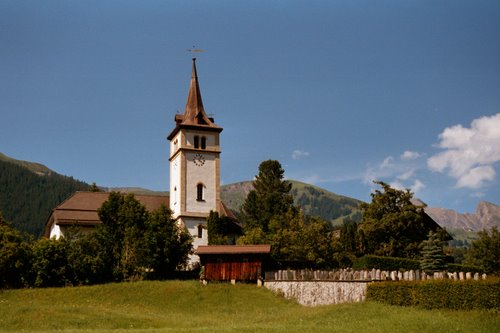
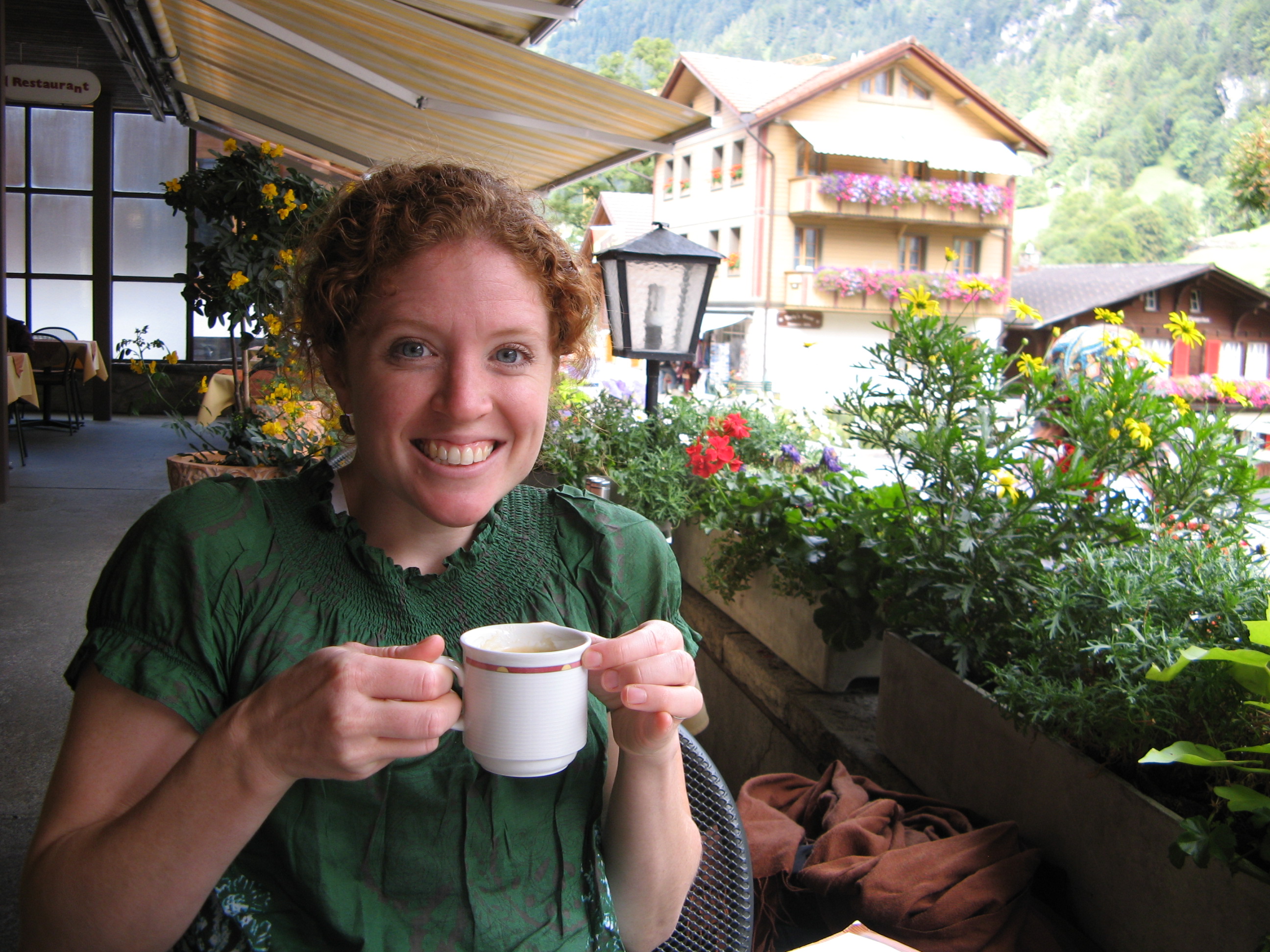
We walked into Lauderbruden from the falls and wanted to find somewhere to have warm soup. The grass was so green, I felt alive and free and open, even in the gorge, as if it made me feel that way with it’s shape. Waterfalls looked like they were falling on houses, and no one here even gave them a second glance. We sat on the front porch of a restaurant and had soup and coffee. Phil’s shoulders hurt, but I was doing ok with most of my backsack weight around my waist.  We admired the green roofs and pristine graveyards of the town. There were places to camp before we came into town. It was here that I realized the direct effects of coffee. It made me happy. No wonder I loved Italy so much. At the top of every peak, around every corner, just outside every church, there was coffee… but that finding was yet to come.

.

After lunch we walked to Wengen to get a train lift to Grindelwald. Phil, I learned, was more direct and perceived the reality of situations better than I did. Traveling with him was such ease compared to trying to figure it out myself. We boarded the train he suggested and in only a few moments found ourselves walking off into the wild wonderful world of tourist driven Grindelwald!

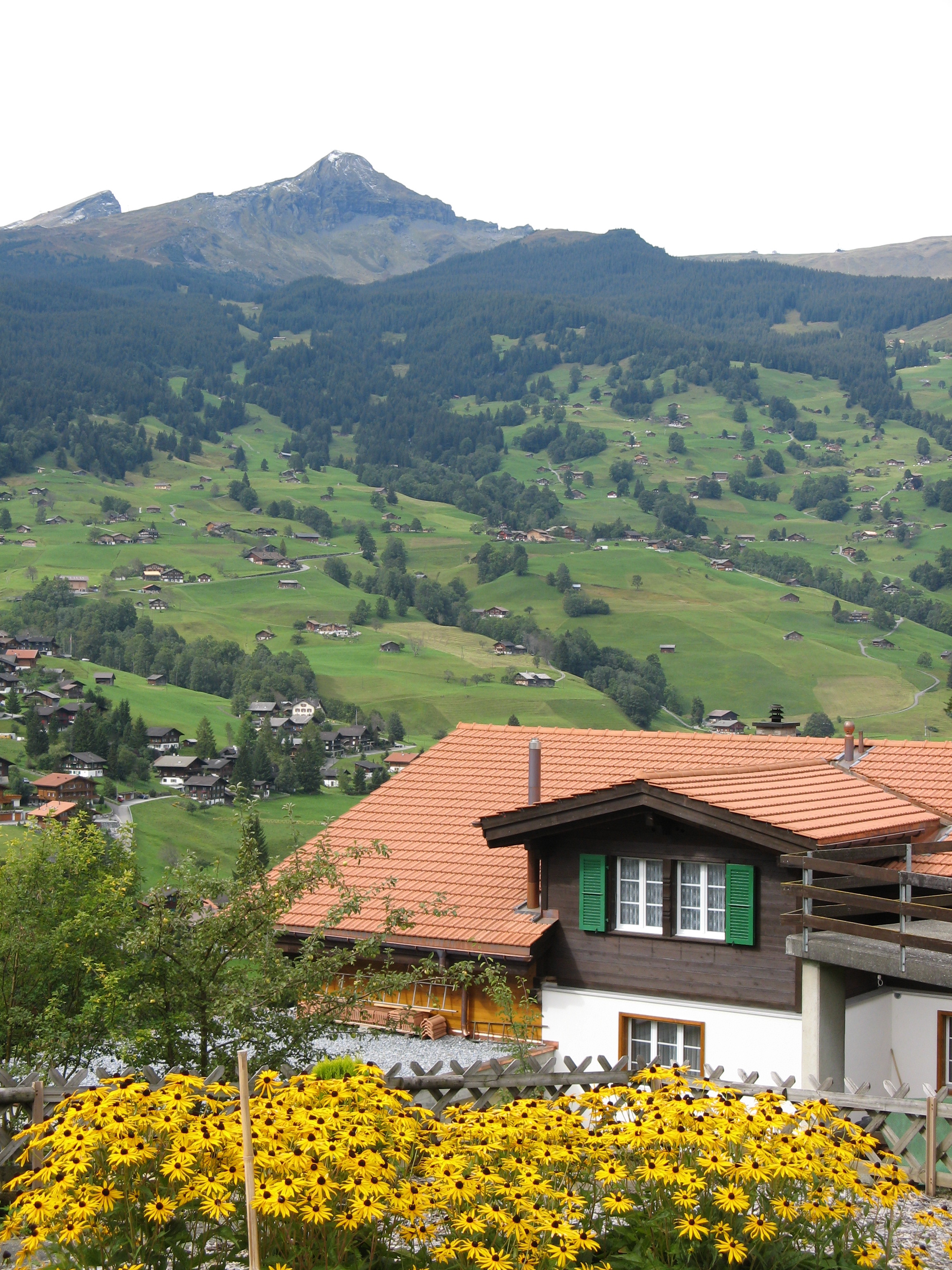
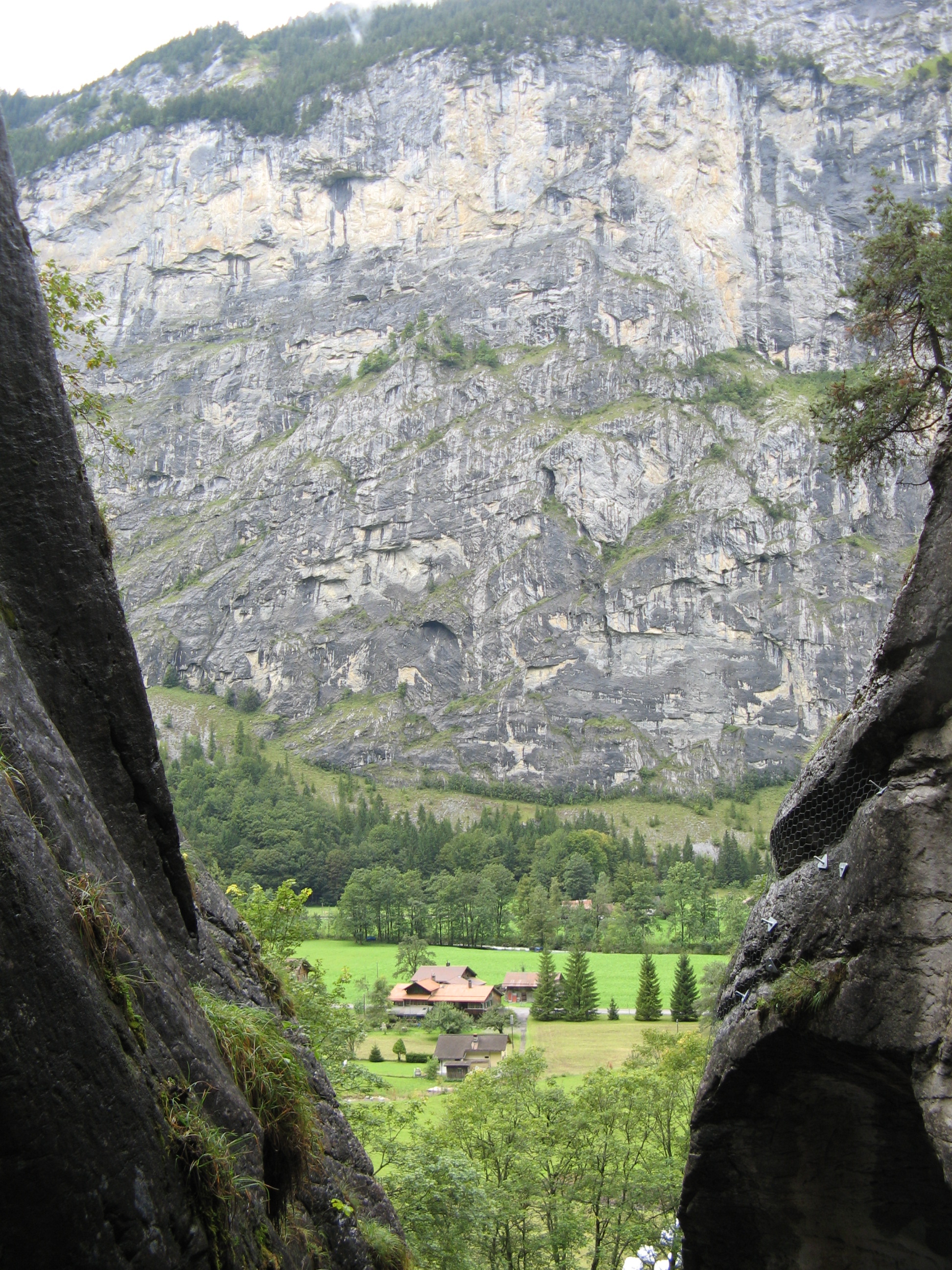
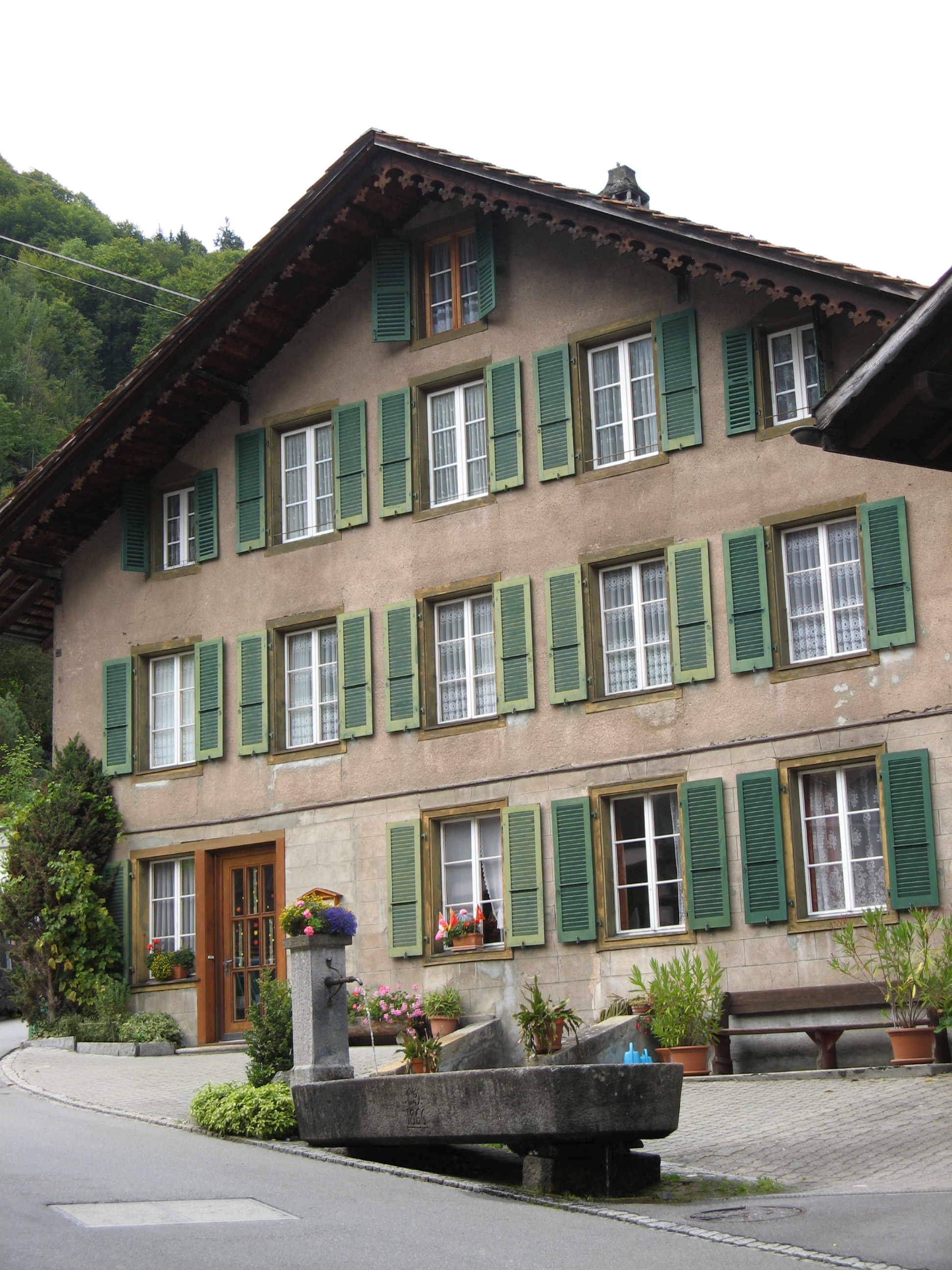
I took this photo as we were leaving the Gorge, just before boarding the train.

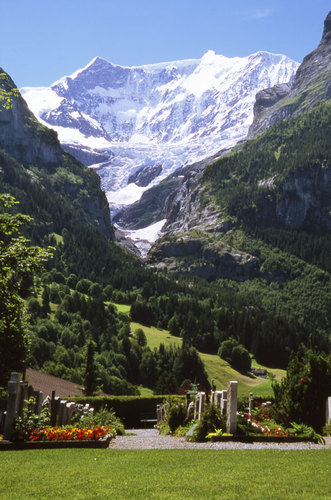
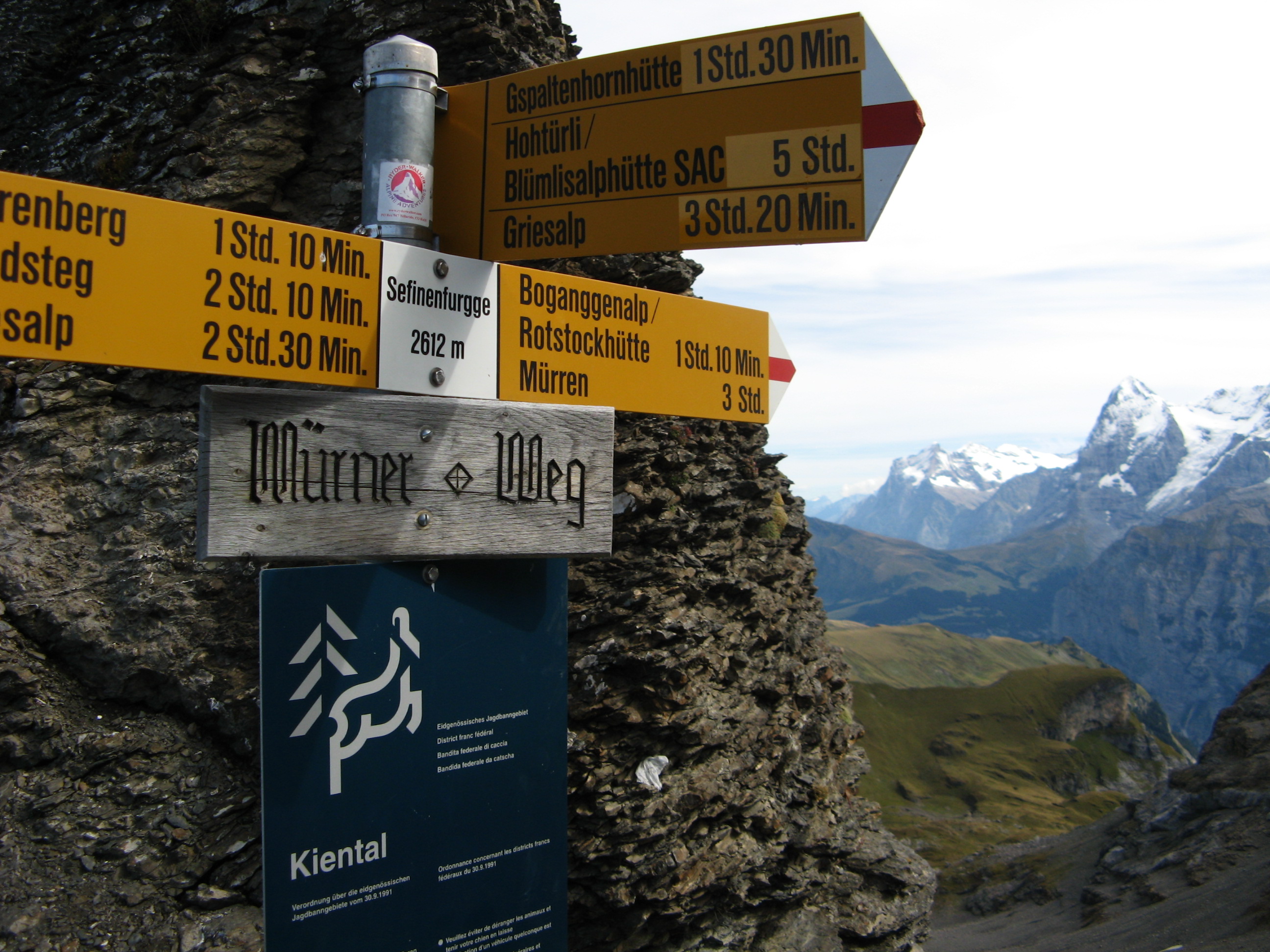
The wonderful thing about Switzerland is that the directional signage is spot on. Many signs described our hikes along the way, telling us exactly how long to expect it to take and luckily, the signs were just at our pace. The same held true for arriving in a town and finding your accommodation. We found The Downtown Lodge without problem.  If there was one hotel I wished not to find, it was this one. We didn’t have a problem the two nights we stayed there, I just couldn’t sleep. I wanted to open it up and paint everything white. I don’t trust old looking carpet and I am afraid of bugs. The coffee was good though and Phil wasn’t too upset considering our view out of the window.

That would be mighty Eiger. We quickly unpacked and organized our belongings so that we could go discover this Swiss town. We were progressively, since Griesalp, staying in larger and larger towns, until we would find ourselves in Interlaken before moving south to Italy.

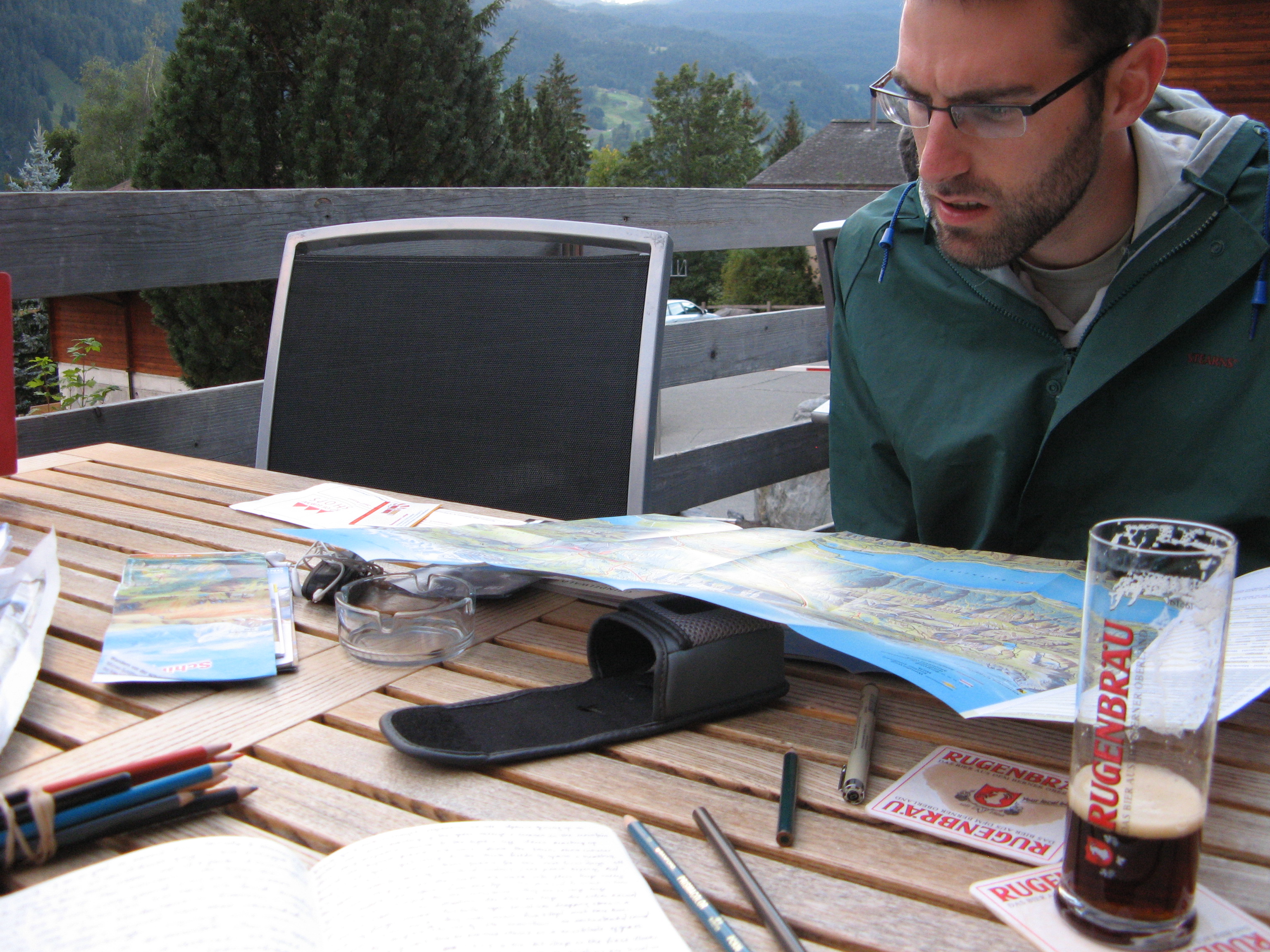
We found Cafe Bar C & M nearby. Wanting to take in the beautiful surroundings on the deck outside, catching a mountain sun setting, was made warmer by the fleece blankets provided by the staff as we decided to order beers, write and read. Phil began studying the map, which became a favorite dinner pass time for us on our entire trip.

The servers say cheers when they bring the beer and wine. We moved inside and sat upstairs in a loft on upholstered chairs in a very chic restaurant with only a few tables. I didn’t imagine this was up the stairs from the small bar downstairs. I like .3 liters of beer, a medium size. My face feels warmer after sun down. We are tired after dinner but decide to take in desert in another nearby restaurant between us and home. Either that or I am avoiding our accommodation. I had a great sleep, a full stomach, and woke up early to write before Phil joined me for breakfast.


Categories
Travel

Griesalp to Murren

Day 3

Respect the Cliff. Respect the Mountain. I climbed the Alpen.

Another fantastic site to check out where to stay when you want to hike the Alps is Map.Wanderland, a Hiking in Switzerland website.

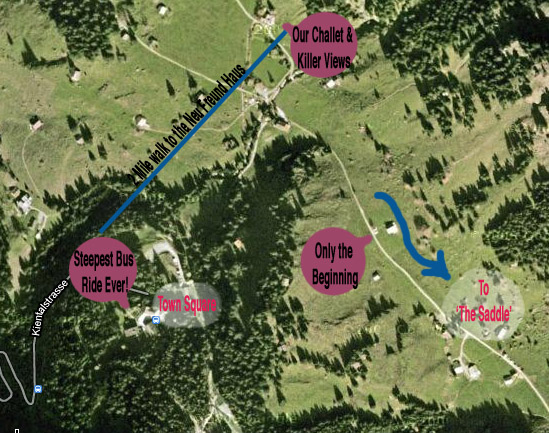
We were hiking a National Route called the Via Alpina. From Griesalp to Murren is considered a section. We went from Griesalp, where we stayed at the Naturfreundehaus Gorneren (considered not to be in Griesalp but Kiental, the next city over.. however only a two-mile walk from town center Griesalp and right on our trail) and climbed the saddle Sefinenfurgge to get to Mürren for the evening. We found Hotel Regina in Murren just as the rain was coming in over the west pass of mountains.

Ah, but lets start at the beginning of our day.

The cow bells stopped ringing about 3am. I can still feel our foamy bed covered in a picky warm sheet. Welcome to real Switzerland, where the Alps are your neighbors. We woke up very early for the first week of our honeymoon, adjusting to the time. Outside of our warm room the hallway was cold. Breakfast downstairs; the coffee, the sweet muesli in milk, toast and jam was good and filling before we prepared for a hike that was to compare in difficulty to Mt. St. Helen, the one that we did last year. ‘Watch your footing,’ Bob from Bend said. I made sure the 64oz of water in my backsack was centered. We said goodbye after potted pictures and started our journey.

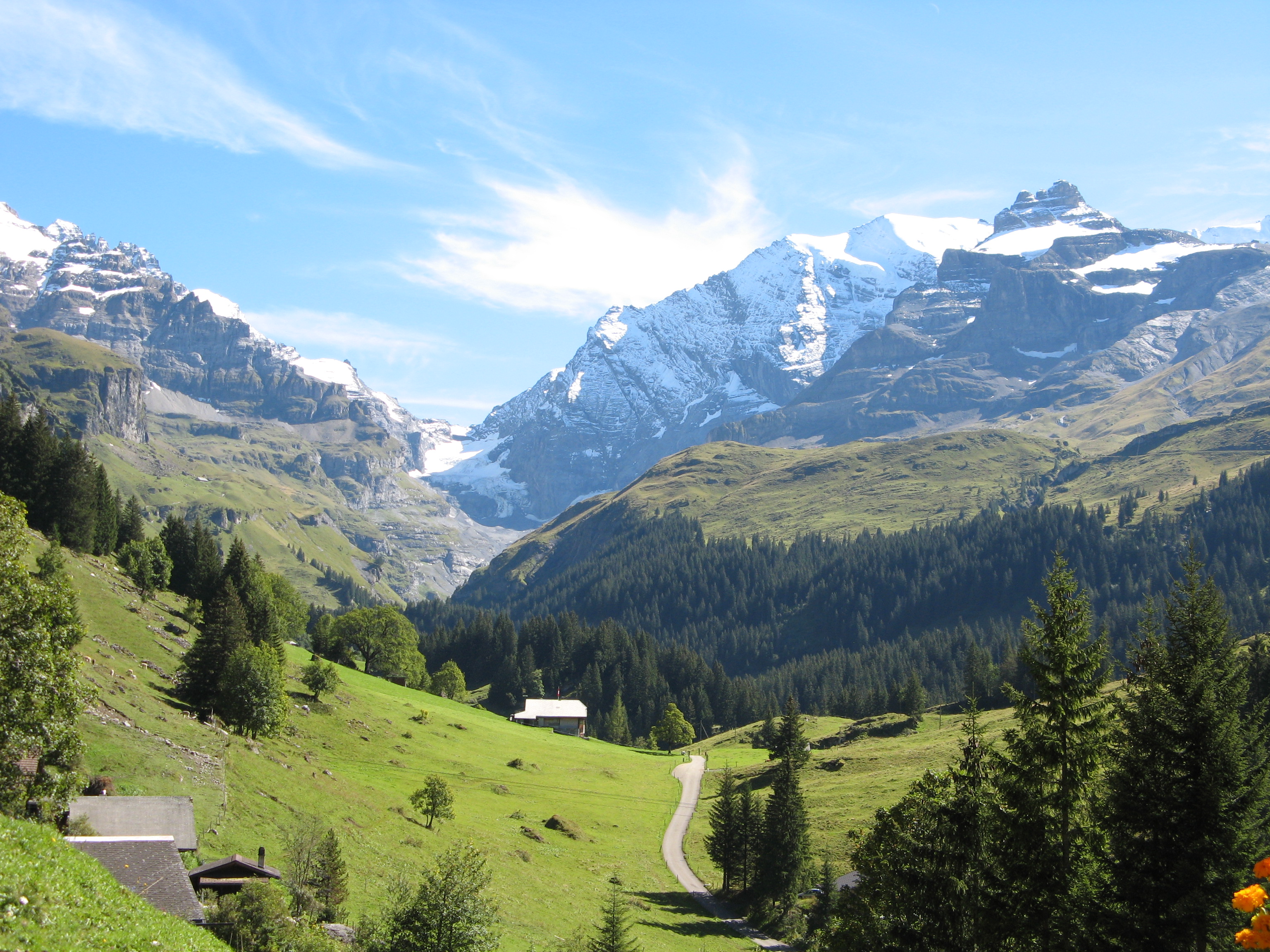
This is a look back to Griesalp once we began to climb the saddle.

Hiking from Griesalp to Murren over the saddle, ‘Sefinenfurgge’ took approximately 8 hours. We began about 9 and arrived before 5 in Murren, just in time for the rain showers -with a beer stop for about 45 minutes mid way.  I give this hike ‘The Best Hike in the World Award.’…160lb woman climbs Die Alpen!

I will describe it.

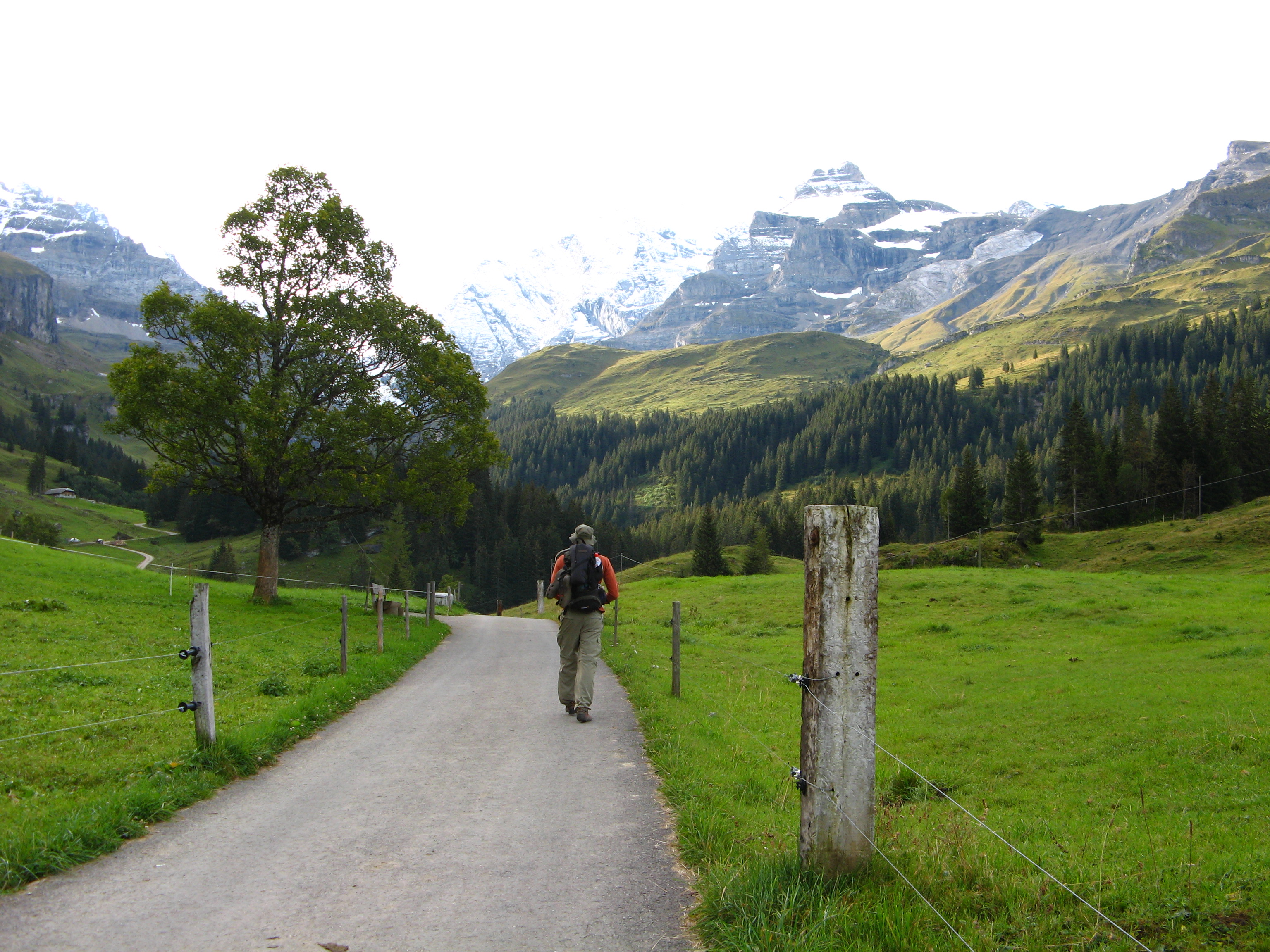
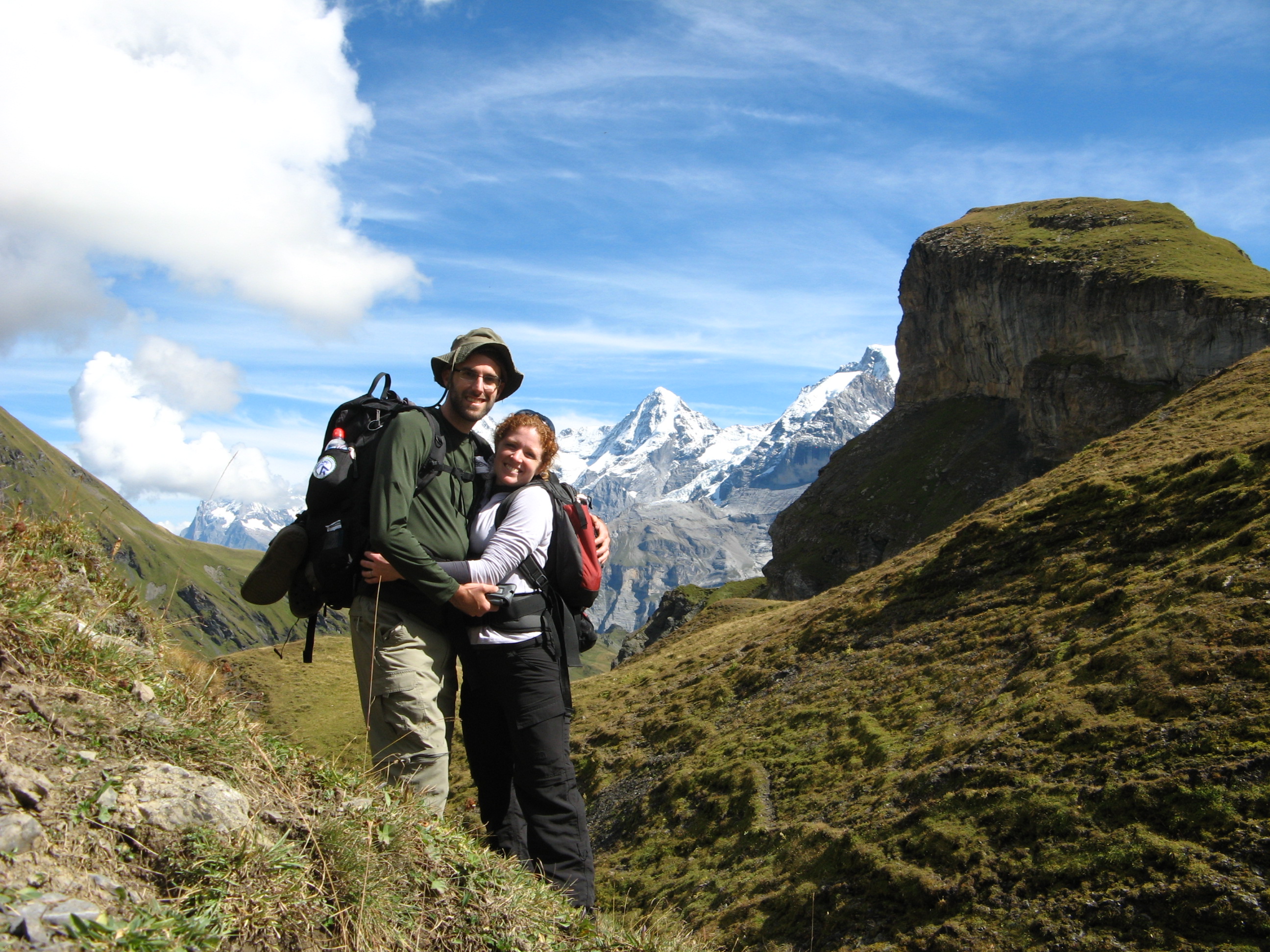
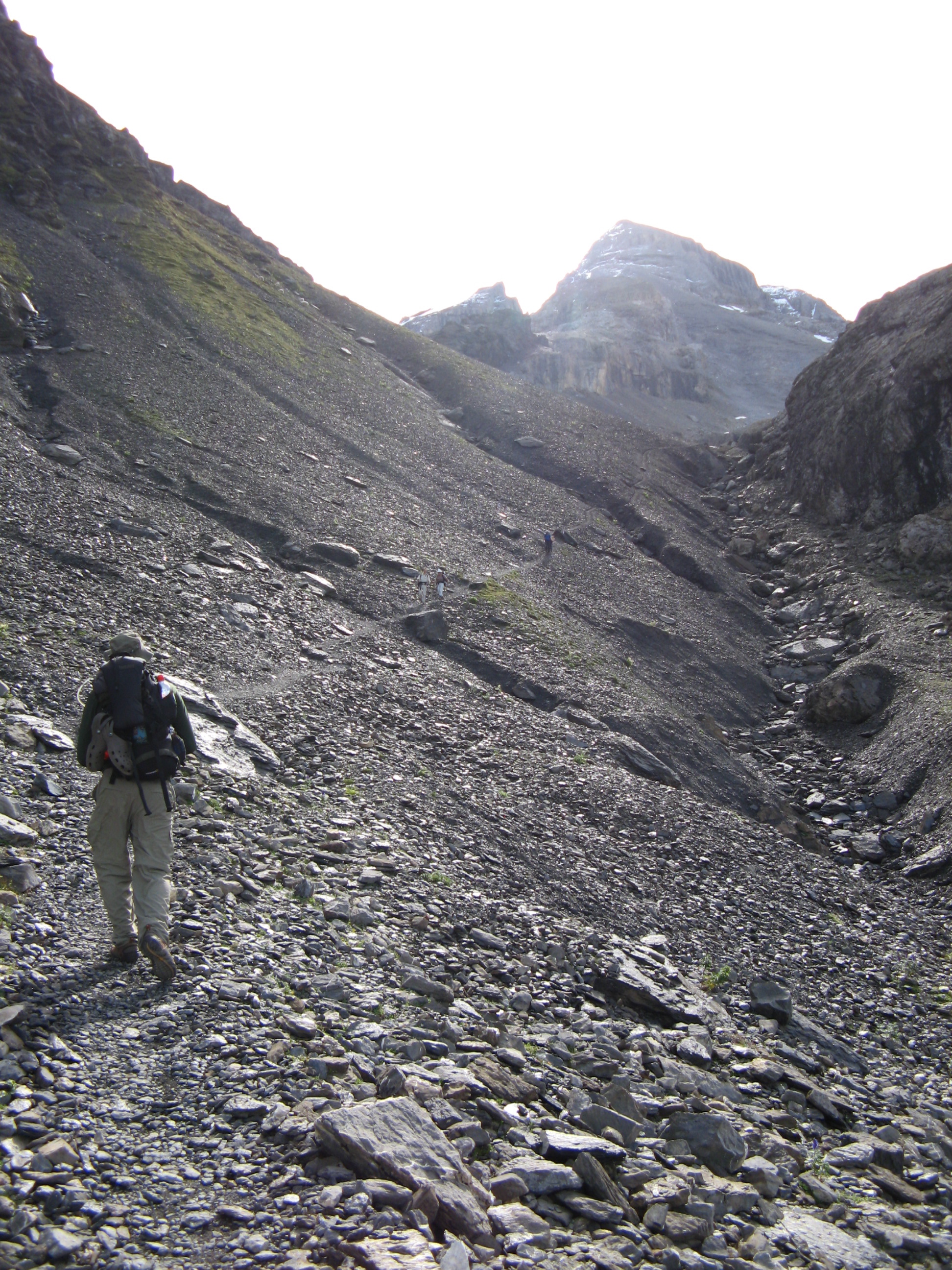
We began at Neufrenhaus, two miles outside of Griesalp, which is on the Via Alpina hiking trail. We walked toward a cork in the landscape -a circular part of land that looked like it’s raised portion had popped up out of the earth. From our chalet it took forty minutes to get to. This hike, which took us into the next town of Steinbergh began on a paved road, past alpacas (buy Alpaca wool signs said!), which led to a gravel drive, then terminated in a suisse country house. There was a blonde 3 1/2 year old who was outside playing in the sawdust pile in his goloshes -we told him hallo. At the house there was a latched gate that we assumed to be the way of the trail. Later confirmed by the white, red, white, stripping painted on a rock to show us we were on the trail, going in the proper direction. As the grass wore out, we crossed heather and pebbled streams. There were black friendly sheep crossing too. Sheep had climbed up very steep mountain sides that amazed us. Then we came to black shale, some fist-sized black rock, large bolders on switch back trails which eventually lead us to a barren -oil spill landscape. The sky was clean, the air crisp, and we were in a cold sweat.

You could see small people way above and I was leery of actually seeing the check-marked saddle because on other hikes, where mountains are involved, there are many false peaks. Outside of the black landscape we were hiking through, we came closer to the rigid order of mountain tops we could see from our chalet porch the day before. They were much wider, flatter, and snowier when seen at a closer vantage point. They were beautiful and stark on this side of the saddle. The sun reflected directly off the shiny back ground and warmed us plenty.

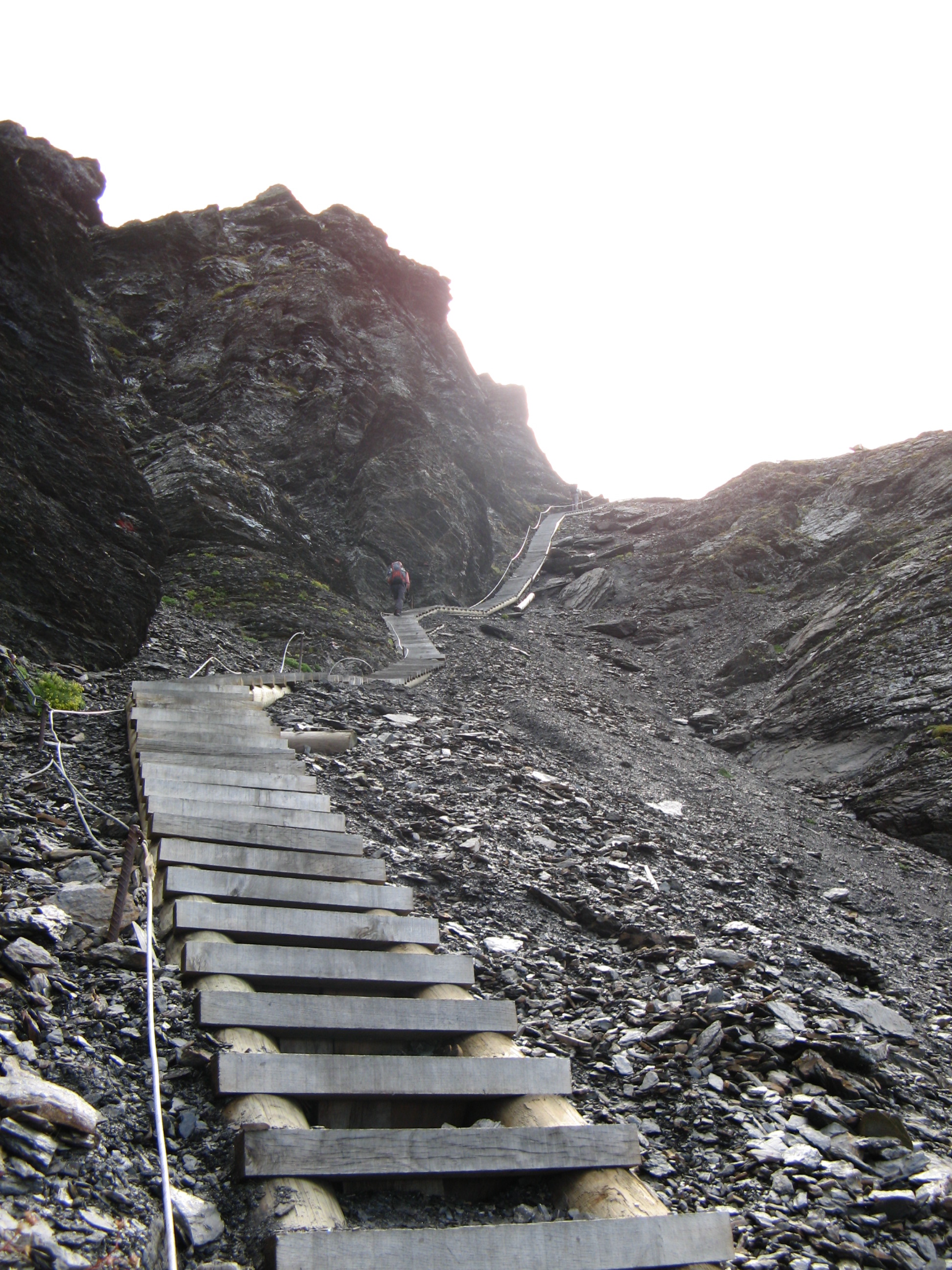
We saw wooden steps, 1-2 hundred of them that were to bring us to our passage into the second half of our hike down.

(This photo looks back at where we were coming from.)

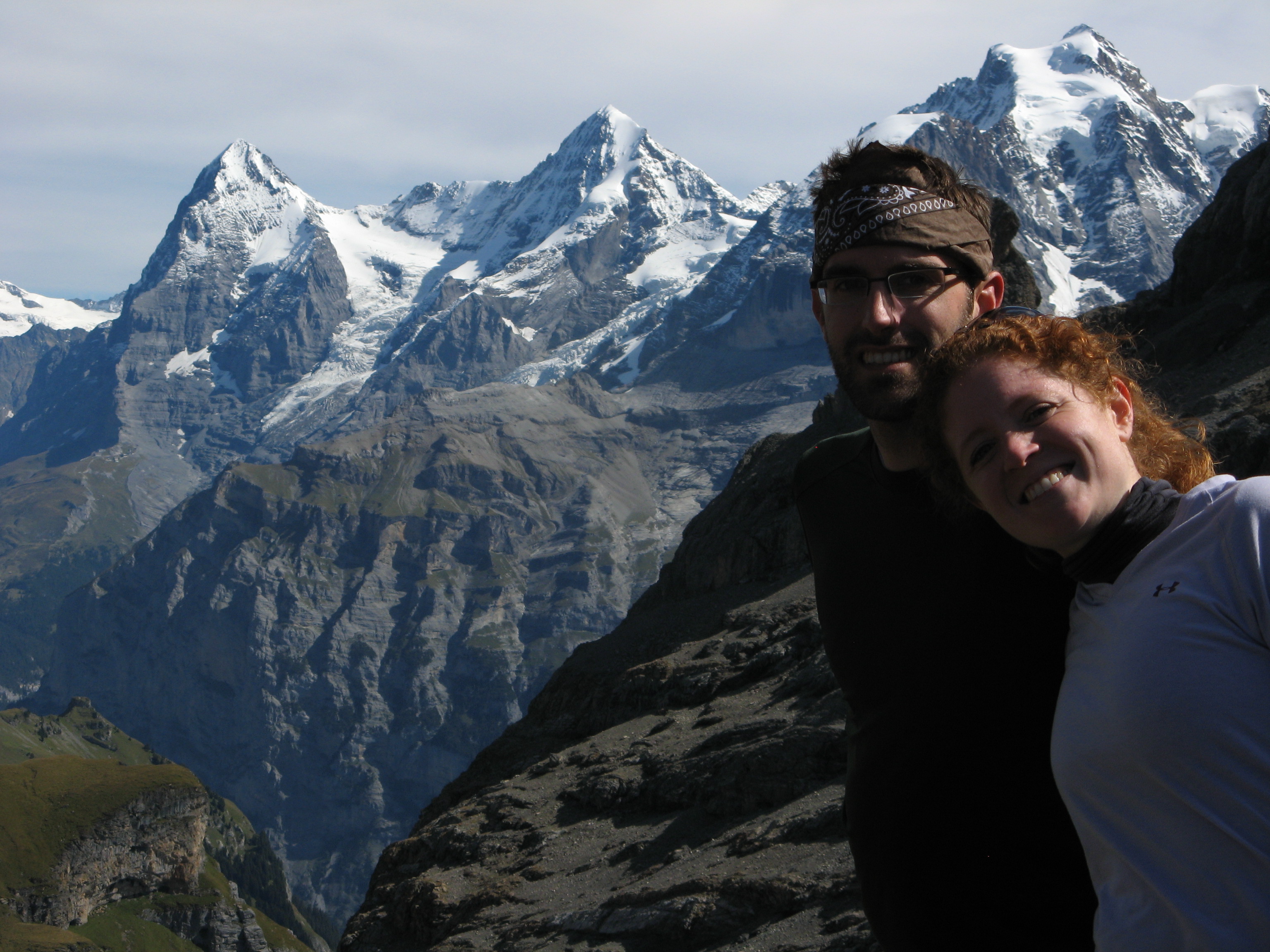
We walked hand in hand up to the ridge and saw the most beautiful world ~ three sister peaks of Eiger, Munch, and Jungfrau faced us. A spine of land -Poganggen ran just down from where we sat into the alpine view. To the left our ridge rose above us and circled back into a cove -our view, on top of which a 007 scene was filmed in a Bond get-away scene. There was a restaurant built up there somehow.

Surprisingly, there were a lot of people up there. Many people we crossed paths with on our way down were from the U.S. west coast, D.C. people… We earned our lunch and view, so enjoyed sitting for a while on the saddle. At that point you realize that it’s cold, when you have stopped moving and your sweaty shirt isn’t insulating against the wind anymore. It is amazing to think we were sitting at a desk only four days ago, in a world that is six hours younger than we are, as we are standing in the Switzerland alps now.

We had to move again, so started down the steep dark rocky side, going east. We walked down in the grass, the trail sunken into the ground, a soft mud path. There were beautiful small flowers, the sun, the underside of a small looking hill from one angle became grand as we steeped closer into the panoramic.

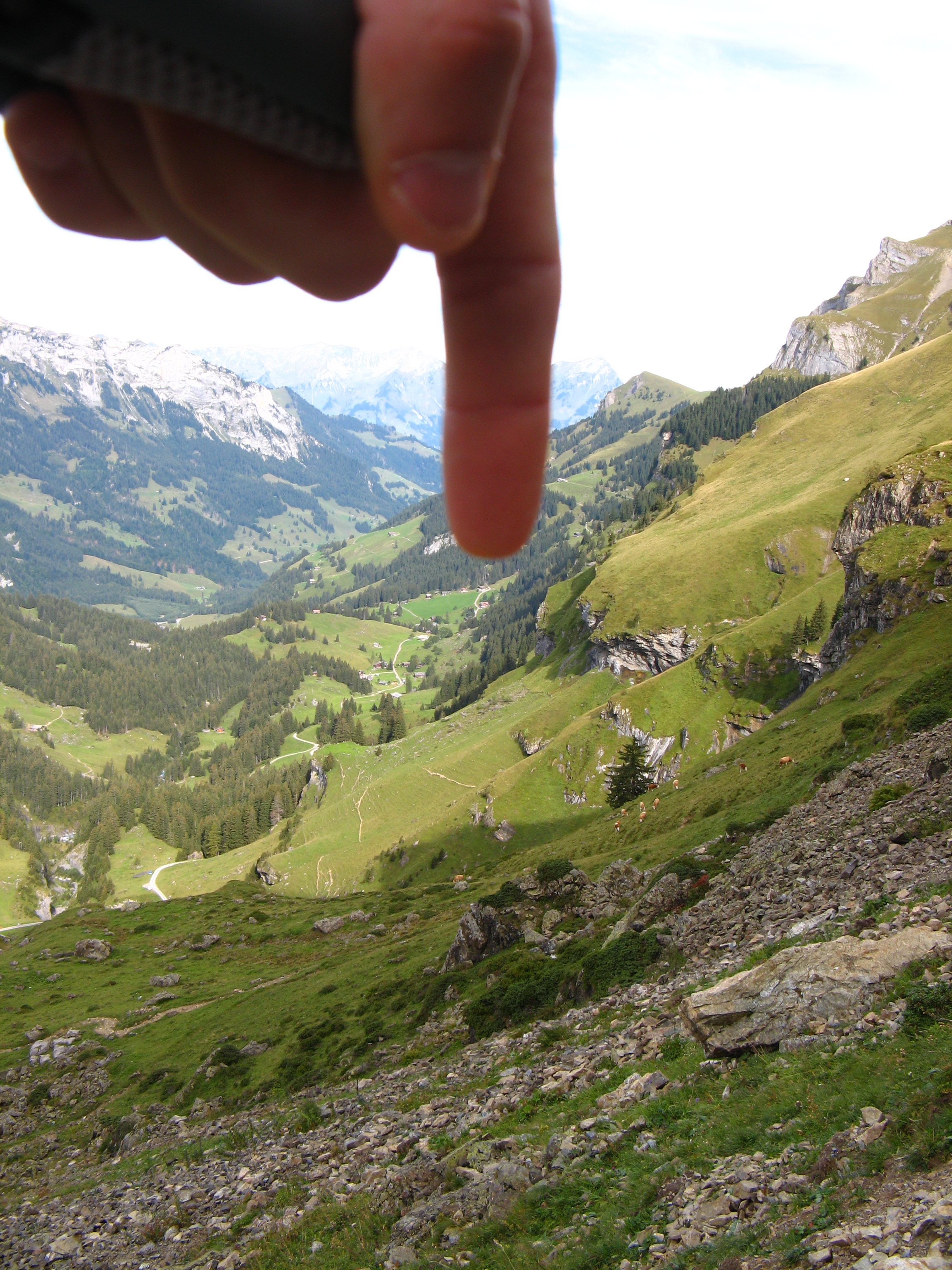
Our breath being taken away at the size of the rock, we could see the start of a gorge we’d be spending the night on the cliff of – in Murren. Slowly the mighty and high alps gave way to less dramatic peaks, and became over sized stalagmite hills, pronounced from the ground in even orders, working their magnificence down from the grey alpine rock, the black faces of huge mountains, and then snow-capped peaks. Something that looked so close -a town, a mountain, a rock, was so far.. maybe 1 1/2 hours of walking sometimes.

Can you see the check marked place which is the saddle passage?

As our path veered and our easy hike traveled down, east and north, we came to see the Rock-Stock-Hut.. or at least we think that’s how you pronounced it. Say it at least two times… it’s fun. Our bodies were tired, but this beer bungalow was a day hike for people staying in Murren or Gimmewald. Two hours from each we thought. We had a self-serve brew out in the picnic table area and stripped down to a few layers for the remainder of our decent into Murren.

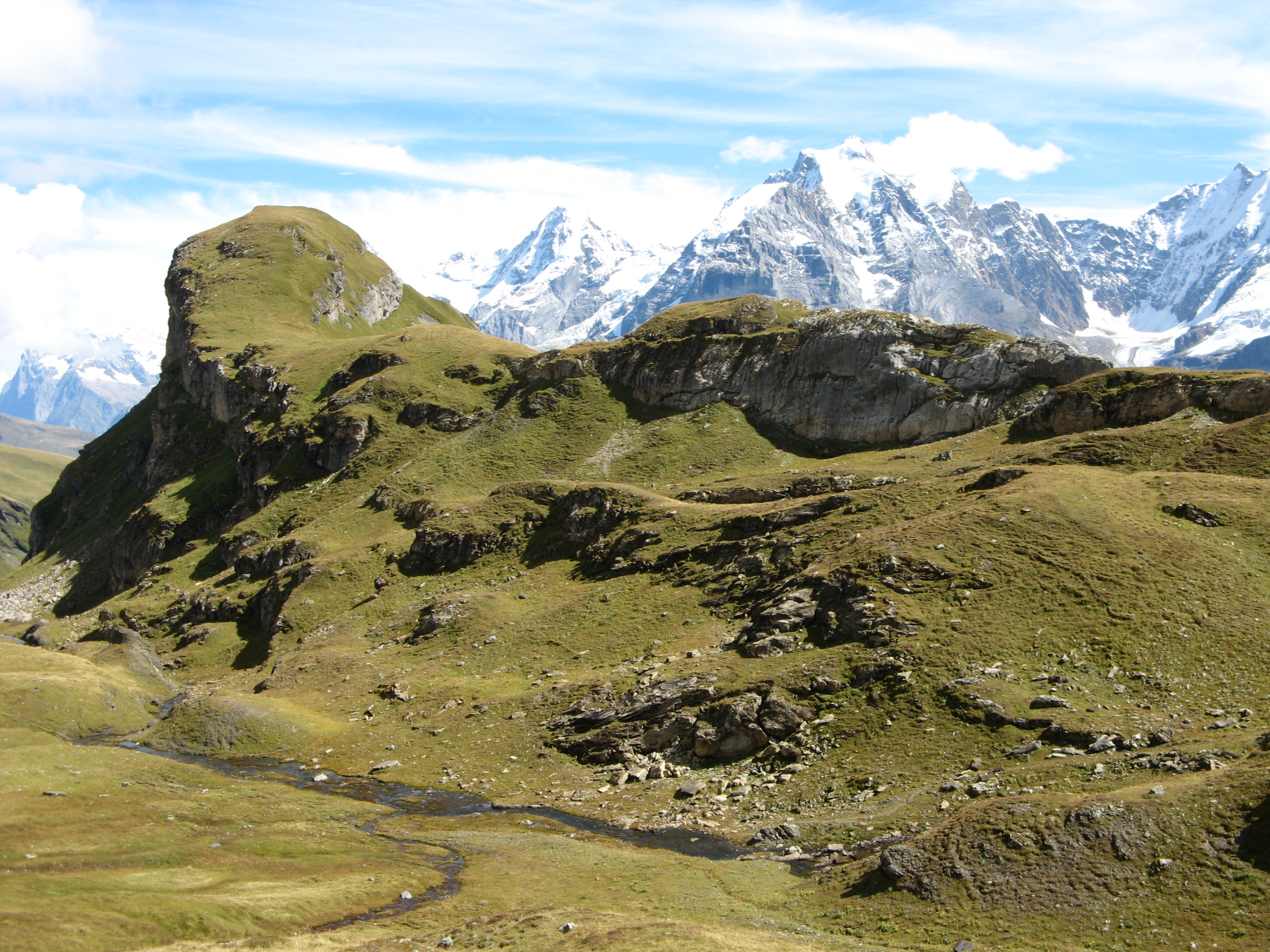
As we could see Murren in sight, we could also see a storm. Black clouds in the west, over the ridge we were now on the other side of. We hurried down the face in Brindli -this rock, crooked and cragged hill with a trail you couldn’t even tell was there, except for what was five to ten feet ahead of your step.

This is a view of Brindli, where we just came down the hill.

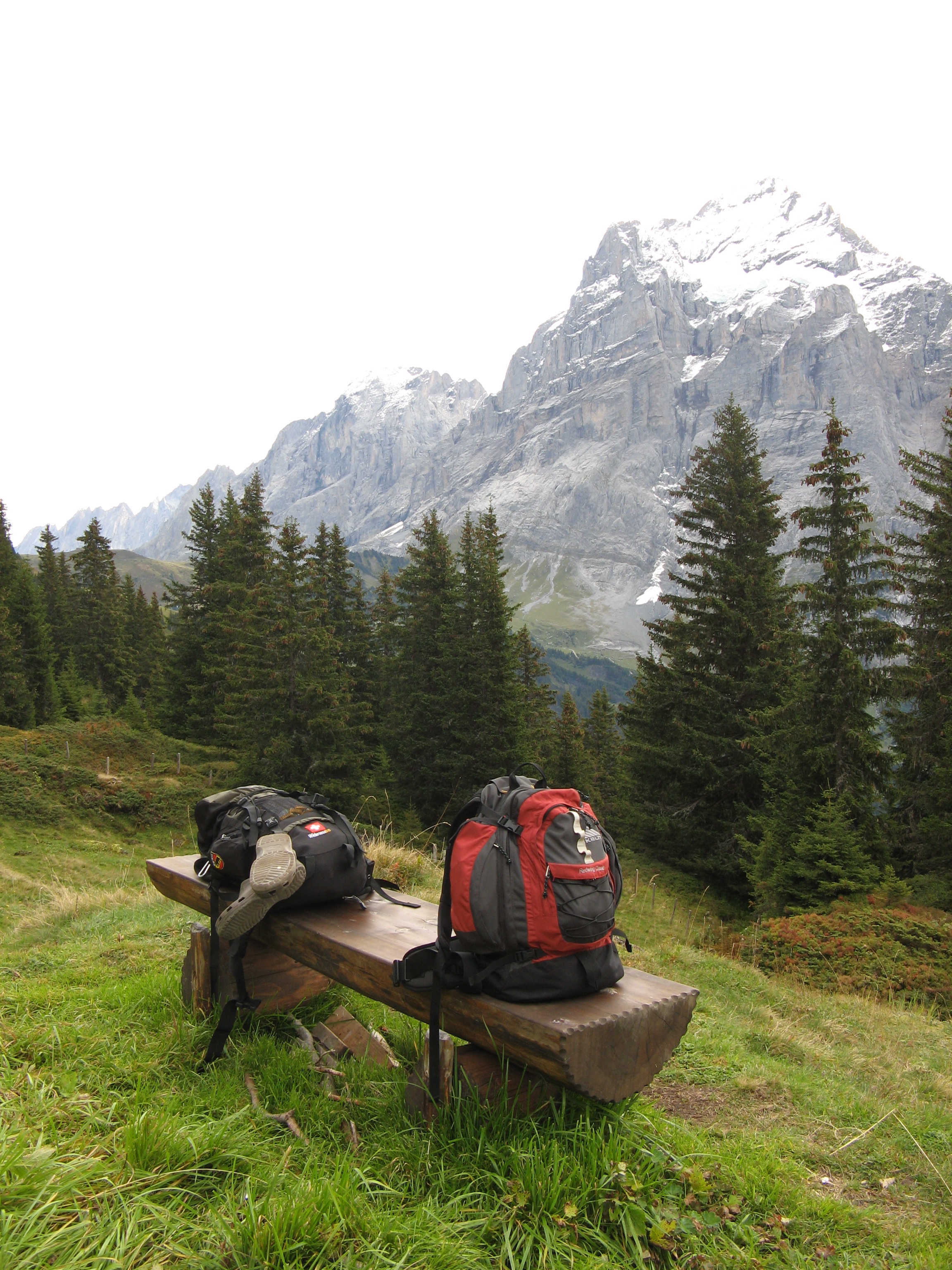
This really was hard on my knees, you had to bend down as far as you could, reach the next worn earth path and do that again in about five steps in the opposite direction. We were hurrying because we weren’t familiar with mountain fog or the Swiss mountain storms. We stopped after crossing through a farm’s front yard just below some high pines. There was a wooden bench there where we pulled out our rain covers. Thankfully, because nor arrival into Murren was a rainy one.

Murren from about an hour and a half away.

The small mountain town had streets that were pretty desolate! Hotel Regina looked like an old school-house. It had a tall brown face that could have been a bell tower -large open rooms on the bottom floor and had a large central stair with terrazzo poured floors. It was empty, echoing but the curly blonde girl at the desk was so sweet. She suggested a close place for dinner. We were wet and staving, but showered in a tiny square room and settled in our peach colored, high ceilinged room before venturing out again into the rain.  My legs were tired and we were both sleepy. We carried with us our language translation book and found everyone in this swiss town spoke English. We had our first taste of Rosti, a swiss potato hash brown smothered in cheese with an occational veggie atop for kicks.

(Not actually my dinner.. but pretty close)

The wooden chairs were carved and hard. The restaurant was empty. We were able to witness a four-some coming in.. one woman plunging to the back of the restaurant to where we sat saying ‘I don’t think this is it.’ She asked our waitress ‘Is this a Rick Steves restaurant?’ and our confused waitress didn’t know ow to respond and this was when Phil and I began to understand the Rick Steves phenomenon.  Everyone in Italy is carrying  a Rick Steves book! But, when they determined this restaurant was not recommended by him, the left.. us in peace.

It was dark with fog outside and the rain was cold. We bought post cards and admired the 3D topographic terrain map of the Alps on the wall of the restaurant before walking out to town in the rain. We’d seen the hotel on the edge of town when we were walking into Murren. We guessed this place was amazing through the winter months, more full of people. Maybe hiking season had passed too, but it was great for us.

Here is some of what I wrote that night in my journal…  I am so glad we walked from Griesalp to Murren and not the other direction. It was difficult going up but I thought it could have been much worse, especially with a 30lb pack.  It has been the best ten miles in the world.

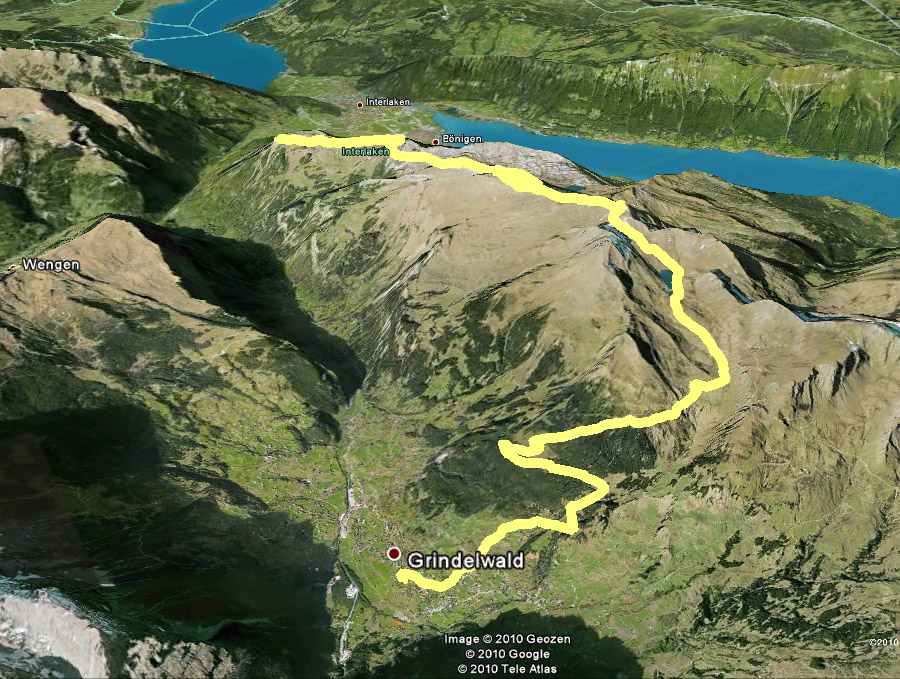
Below I show a photo rendition of where we hiked in the Alps. Tomorrow we will go down to Gimmewald from Murren and walk into the gorge.


Categories
Book Review Environmental Poetry

On account of Thoreau; Walden

.

I have noticed that Walden, by Henry D. Thoreau is frequently referenced in news media. Architectural Record has mentioned the book at least three times in different issues through out the last year (Robert Ivy, Cabin in the Woods, and a recent Record Homes issue), ‘The Happiness Project’ by Gretchen Rubin mentions it and I’ve read reference to Thoreau’s time in the woods in House Beautiful Magazine too. In different accounts of finding your own spirit, the humbleness in building one’s own house, and in the action of filling out the creases, finding your own character, Walden represents an acute account of the life that surrounded Thoreau while in the forest.
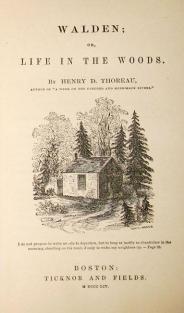
He writes, ‘The earth is not a mere fragment of dead history… -not a fossil earth, but a living earth; compared with whose great central life all animal and vegetable life is merely parasitic.’ ‘You may melt your metals and cast them into the most beautiful moulds you can; they will never excite me like the forms which this molten earth flows out into.’ (From the chapter Spring p334-335 in the Edition by Yale Press 2004.)

For two years, two months, and two days, time did not matter. What did was instinct. Thoreau moved to the forest around Walden Pond July of 1845. Having built his home that spring, March 1845, at the age of 27. He farmed beans, made loaves of bread, bathed in Walden, and perceived life in the forest. He built a chimney before winter. He watched the lake and measured the boundaries. Discovered ice and placid waters for looking to the bottom. He marveled at the colors of fish, at perfect round stone temples at the bottom of Walden lake and witnessed a fearless battle of the red ant versus the black ant nation. He spoke heroically of their manners and watched the black ant win (all other red ants around him had died), and then leave without antennas and with crippled legs.

165 years later his accounts of society and tradition are still pertinent if not more so complicated and diffused. He moved to the forest to ‘transact some private business with the fewest obstacles.’

Thoreau’s book begins with the chapter titled Economy. He describes philosophy, luxury, and the toll of ownership. ‘I see young men, my towns men, whose misfortune it is to have inherited farms, houses, barns, cattle and farming tools; for these are more easily acquired than got rid of.’ p3 ‘What is the nature of luxury which innervades and destroys nations? p14

I began to read Walden during the travels of a month-long honeymoon. This is what I wrote upon reading the first few pages. It is here that I am seven days into spending time as I wish. Fulfilling my days with challenging hikes, reading and writing to reflect. Drawing and learning to color. Challenging myself to keep track of the mountains and relate them in drawings. My husband draws the landscape. We eat and drink often. Time doesn’t matter. We are aware of our few belongings and are taking better care of them and one another. I think I own too much at home to myself to take care, and do not work as apart of my community or neighborhood to feel kinship or pride to stand together.

What society celebrates as success is a form of acquiring methods to bind your freedom. When you own land, a house, manage a family and animals, crops, or when you become a vice president, receive position on an authority board, -people, buildings and organizations depend on your opinion and presence. Late in Thoreau’s book he describes a man being appointed to town duty, -how he may not take vacation… because of his commitment.

I wrote a poem about success while reading the book.

Success

Is success in your picture

the recognition of your face?

.

Is it all you accomplish in your week,

do you remember?

.

Is it the parties, champagne

and fine toasts?

Is success quiet or loud?

.

Is success praise and good doing?

Is it alone or together?

.

Can you define it with

metals, trophies, or certificates?

.

Is it a glitter ball signifying

the turn of a new year?

Is it what we wear

to define our character?

.

Is it found in hard formulas

or in the last line of poetry?

.

Is it the wrinkles on a face

or the exhaustion in your voice?

.

Is it a word at all that can be defined to

so specifically a cause,

.

a word to describe

survival or wealth?

.

Does happiness have a place

within its parameters?

.

Do you remember what

you are chasing, who

you are and where you

are going?

.

Has success been a

purpose for going?

A path and direction

for finding yourself?

.

Thoreau writes

‘The life which men praise and regard as successful is but one kind. Why should we exaggerate any one kind at the expense of others?

If I were to define my purpose under the influence of Thoreau I would say that the point of life is to keep up ourselves without running debt and reach for the heavens.

Thoreau writes that he went to the forest to ‘transact some private business with the fewest obstacles.’ The fewest expectations, the fewest interruptions, -a living forest and lake that ask nothing of you, -just that you live with them. In the chapter Pond In The Winter (p314-315) Thoreau describes the laws to which he found he was part of in the forest. ‘If we knew all the laws of Nature, we should need only one fact, or the description of one actual phenomenon, to infer all the particular results at that point. Now we know only a few laws, and our result is vitiated, not, of course, by any confusion or irregularity in Nature, but by our ignorance of essential elements in the calculation. Our notions of law and harmony are commonly confined to those instances which we detect; but the harmony which results from a far greater number of seemingly conflicting ,but really concurring, laws, which we have not detected, is still more wonderful. The particular laws are as our points of view, as, to the traveller, a mountain outline varies with every stop, and it has an infinite number of profiles, though absolutely but one form. Even when cleft or bored through it is not comprehended in its entireness.’

Thoreau describes society. p147 ‘Society is commonly too cheap. We must meet at very short intervals, not having had time to acquire any new value for each other. We meet at three meals a day and give each other a new taste of that old musty cheese that we are.’ (That made me laugh.) We have had to agree on a certain set of rules, called etiquette and politeness, to make this frequent meeting tolerable and that we need not come to open war.’ ‘Certainly less frequency would suffice for all important and hearty communications.’

‘What sort of space is that which separates a man from his fellows and makes him solitary? I have found that no exertions of the legs can bring two minds much nearer to one another.’ p144

(I think this is comical too.)

‘It is a ridiculous demand which England and America make, that you shall speak so that they can understand you. Neither men nor toad-stools grow so… As if there were safety in stupidity alone… The words that express our faith and piety are not definite; yet they are significant and fragrant like frankincense to superior natures. Why level downward to our dullest perception always, and praise that as common sense? The commonest sense is the sense of men asleep, which they express by snoring.’ p352-353 He asks men to ‘soar but a little higher in our intellectual flights than the columns daily in the newspaper.’ p115

Silence plays a large role in securing the availability of Thoreau’s thoughts. He would spend his day… ‘After hoeing or perhaps reading and writing in the forenoon, I usually bathed again in the pond, swimming across one of its cover for a stint and washed the dust of labor from my person, or smoothed out the last wrinkle that study had made, and for the afternoon was absolutely free.’ p182

Our book club discussed what the modern life takes away. One member talked about the dross, the useless information the average person wastes their time knowing. We entertain ourselves with thinking this useless information is important, and it takes up all of our time. TV.

I began to compare silence and expectations. Thoreau’s phrase ‘I came to the forest to transact some private business with the fewest obstacles.’ made more and more sense to me as I continued reading. It was odd that this reading coincided with my own searching for a way to unplan my life -in order to take in the moment and free my thought. The rules, and regulation, fees and traditions, social expectations strip away the free thought -the trueness of acting in the moment -so I’m trying not to make commitments, as a commitment to my happiness and well-being.

He speaks of being alone. p 146 ‘I find it wholesome to be alone the greater part of the time. To be in company , even with the best, is soon wearisome and dissipating.  We are for the most part more lonely when we go abroad among men than when we stay in our own chambers.’ He says this I think to explain the reason he should live alone in the forest, without the expectancies of people.

Here is what Thoreau has to say of weaving a basket, so as to avoid the necessity to which the basket has been made for disheartening purposes. p 19 ‘The poor Indian man can weave a basket and thought it be the rich man’s duty to buy one’… Thoreau weaved one and studied avoiding the necessity to sell one. He talks of trade. p75 How it seems he would commonly do, but would then be expected to… so therefore was like business.. ‘to stay away from if at all possible for fear it may consume all of your time.’ He describes depending on money or work to trade. p56, (On earning wage to travel, or to travel by getting there by your own two feet.) ‘On living somewhere to earn a wage, so that you may move and live the life of a poet… at what point did we decide to separate the earning a living from living -why not marry these two? If you being down the path of earning life and it becomes complex and entangled… you can’t get out from under the earing because you’d built your life on top of it. It is easier not to begin earning a lot and enjoy the benefits of living like that.’

Which makes me think of earning your experiences. ‘The student whose cures his courted leisure and retirement by systematically shirking any labor necessary to man obtains but an ignoble and unprofitable leisure, defrauding himself of the experience which alone can make leisure profitable.’ p53 (Like climbing a mountain, and exhausting yourself, to see the high view!)

Our book club group and Thoreau discussed Higher Education under these terms of learning your experiences and I repeated a discussion between my husband and I about the necessity / requirement of higher education for our children… at the expense of it. It is like I took 5 years off to think and learn around others, to draw, read, and write -to find myself and what I like, what I am like. I was at that time spending borrowed money that I then had to get a job (that required my purchased diploma) to pay off over the next ten years post graduation. Perhaps it was worth thousands to learn how to learn. My college education was hands off, allowed me to travel Europe for three and a half months, taught me to be more self motivating as it came to my work, and taught me that I wasn’t the best. There was a lot of competition between very different people. There were so many people, you had to find yourself to be comfortable, and confident. After graduation, my profession urges other ways for me to spend money. Architects have at least two professional organizations to join. The AIA status requires that one takes exams to earn the credentials of the three letters after your signature. There is a yearly requirement to keep up this registration with continuing education. Why should we ever stop learning? I do not disagree with that. Neither does Thoreau. Why stop learning when we are children? Why stop learning when learning becomes a fascinating endeavor that we can act on as adults?  Time should be cut out for learning, not only earning, once we get to work as our full time employment. I’ve sometimes debated the complexity of such a system that demands more and more time and money to organize and upkeep the requirements, to the need for it myself. The more I make the more I owe. The more responsibility, the more insurance I need. The more I reach the more paperwork I need to order. I like how things are currently, I understand the general upkeep I need to manage and have under control. What new way is there of growing within this? I don’t know what I’ll suggest for my children as they graduate High School.

In Economy Thoreau discusses the purchase of one’s home. p 23 He makes an analogy for spending more than half our life paying for our home. The cost of your house requires that you spend between 15 – 30 years to work to pay for it. I am still wondering what it is worth? Can you create a house for yourself, build it with your own hands so to cost less money? Will your effort make your home more worthy than the exchange of money would have to ask someone else to build it for you?

Is it more about the requirement that you continue paying for it until it is bought, or that it would be the same as renting.. the same money spent to hold yourself under shelter with nothing to show for it after the many years of having done so. Because we must be sheltered… or is the cost of rent or mortgage out of scale with what shelter should cost us? It is a basic human privilege. Think about what we weight against one another; promised time that will turn into money in exchange for our shelter. Think about what you need compared to what Thoreau says about someone rich. p23 ‘or shall we say richer, who could do with less.’

So, what could be the purpose of his free time? To write and to think. I enjoy his observations. p88, On what you get out of a farm…’I have frequently seen a poet withdraw, having enjoyed the most valuable part of a farm, while the crusty farmer supposed that he had got a few wild apples only. Why, the owner does not know it for many years when a poet has put his farm in rhyme, the most admirable kind of invisible fence, has fairly impounded it, milked it, skimmed it, and got all th cream, and left the farmer only the skimmed milk.’ p215, On pity the farmer…’who loves not the beauty of his fruits, whose fruits are not ripe for him till they are turned into dollars.’

Time away meant time to be natural, adhere to the natural rules which man may find in the forest. Living in the forest allowed him ‘To be truly awake -those first few moments of morning -to which no mechanical means should awaken us.’ p 96

In the chapter Sounds he describes ‘My days were not days of the week, bearing the stamp of any heathen deity, nor were they minced into hour and fretted by the ticking of the clock.’ p120

This time for each of us can be spent reflecting and fulfilling our thought and innate gestures. ‘Soar but a little higher in our intellectual flights than the columns daily in the newspaper.’ p115 ‘True wisdom to read with the intensity in which it took to write.’ p106

‘Follow your genius close enough and it will not fail to show you a fresh prospect every hour… when my floor was dirty I rose early.. it was pleasant to see my whole house hold effects out on the grass.. they seemed glad to get out themselves… It was worth the while to see the sun shine on these things and hear the free wind blow on them; so much more interesting most familiar objects look out of doors than in the house.’ p121

On encountering people more naturally, on communication with an old man, an excellent fisherman, ‘Our intercourse was thus altogether one of unbroken harmony, far more pleasing to remember than if it had been carried on by speech.’ p190

Thoreau had time to make these observations and give them to us, his readers. ‘I have been surprised to detect.. a shelf like path in the steep hillside.. worn by the feet of aboriginal hunters…This is particularly distinct to one standing on the middle of the pond in winter, just after a light snow has fallen, appearing as a clear undulating white line, unobstructed by weeds and twigs.’  p197

‘Circular heaps, Indian mounds of rock that floated to the bottom… These lend a pleasing mystery to the bottom.’  p202

‘Walden is a perfect forest mirror in which all impurity presented to it sinks, swept and dusted by the suns hazy brush…’ p206

Our time is free, but quickly gobbled up. Why not enjoy the poetry that crosses your doorway… why does it seem that the simple pleasures go unappreciated, or not noticed at all… can we not believe in such free gifts?

On White and Walden Pond ‘If they were…small enough to be clutched, they would be, carried off by slaves and like precious stones.. but being liquid, and ample, and secured to us and our successors forever, we disregard them, and run after the diamond of Kohinoor.’ ‘Talk of heaven! ye disgrace the earth.’ p218

On being hungry and enjoying food… ‘Who has not sometimes derived an inexpressible satisfaction from his food in which appetite had no share?’ p237

‘You only need sit still long enough in some attractive spot in the woods that all its inhabitants may exhibit themselves to you by turns.’ p249

Or, the loon games Thoreau played across Walden.

In the chapter House Warming ‘…maples turned scarlet… many a tale their color told…Each morning the manager of this gallery substituted some new picture, distinguished by more brilliant or harmonious coloring, for the old upon the walls.’ p261

‘I was waked by the cracking of the ground by the frost…in the morning would find a crack in the earth a quarter of a mile long and a third of an inch wide.’ p296

Of the placid lake, ‘peering into it for a winter drink… it closes its eyelids and becomes dormant for three months or more… Heaven is under our feet as well as over our heads.’ p307

‘I meet the servant of the Bramin, come to draw water for his master, and our buckets as it were grate together in the same well. The pure Walden water is mingled with the sacred water of the Ganges. With favoring winds it is wafted past the site of the fabulous islands of Atlantis an the Hesperides, makes the periplus of Hanno, and , floating by Ternate and Tidore and the mouth of the Persian Gulf, melts in the tropic gales of the Indian seas, and is landed in ports of which Alexander only heard the names.’ p322

Then he wondered about measuring characters, set to mountains. ‘I laid a rule on the map lengthwise and then breadth wise, and found, to my surprise, that the line of the greatest length intersected the line of the greatest breadth exactly at the point of greatest depth… Is not this the rule also for the height of mountains, regarded as the opposite of valleys?’

‘If we knew all the laws of Nature, we should need only one fact, or the description of one actual phenomenon, to infer all the particular results at that point. Now we know only a few laws, and our result is vitiated, not, of course, by any confusion or irregularity in Nature, but by our ignorance of essential elements in the calculation. Our notions of law and harmony are commonly confined to those instances which we detect; but the harmony to which results from a far greater number of seemingly conflicting, but really concurring, laws, which we have not detected, is still more wonderful. The particular laws are as our points of view, as, to the traveller, a mountain outline varies with every step, and it has an infinite number of profiles, though absolutely but one form. Even when cleft or bored through it is not comprehended in its entireness.

What I have observed of the pond is no less true in ethics. It is the law of average. Such a rule of the two diameters not only guides us toward the sun in the system and the heard in the man, but draw lines through the length and breadth of the aggregate of a man’s particular daily behaviours and waves of life into his coves and inlets, and where they intersect will be the height or depth of his character.’ p313-315

‘The old man, who had been a close observer with Nature -told me, and I was surprised to hear him express wonder at any of Nature’s operations for I thought that there were no secretes between them.’ p328

‘Few phenomena gave me more delight than to observe the forms which thawing sand and clay assume in flowing down the sides of a deep cut on the railroad through which I passed on my way to the village, a phenomenon not very common on so large a scale, though the number of freshly exposed banks of the right material must have been greatly multiplied since railroads were invented. The material was sand of every degree of fineness and of various rich colors, commonly mixed with a little clay. When the frost comes out in the spring, and even in a thawing day in the winter, the sand begins to flow down the slopes like lava, sometimes bursting out through the snow and overflowing it where no sand was to be seen before. Innumerable little streams overlap and interlace one with another, exhibiting a sort of hybrid product, which obeys half way the law of currents, and half way that of vegetation. As it flows it takes the forms of sappy leaves or vines, making heaps of pulpy sprays a foot or more in depth, and resembling, as you look down on them, the laciniated lobed and imbricated thalluses of some lichens; or you are reminded of coral, of leopards’ paws or birds’ feet, of brains or lungs or bowels, and excrements of all kinds. It is a truly grotesque vegetation, whose forms and color we see imitated in bronze, a sort of architectural foliage more ancient and typical than acanthus, chicory, ivy, vine, or any vegetable leaves; destined perhaps, under some circumstances, to become a puzzle to future geologists…’ p 330 – 331  ‘Man…a mass of thawing clay.’ p 333

‘It was pleasant to compare the first tender signs of the infant year just peeping forth with the stately beauty of the withered vegetation which had withstood the winter.’ From the chapter Spring (my favorite.) p 335

Natures rules play a part in my understanding of what I think I know. Like the mountain at every step, the form is the same, but I see a different character around every bend. I am but a small imbecile beside this great rock of earth. How the rules of nature influenced Thoreau after his time at Walden can be found laced throughout his later work, and in how he chose to live after being alone in the forest. Our experiences shape us, what we read and think, discuss and try. Thoreau says that traveling should influence your character, and after a month abroad, I am making the effort to settle in with what I have learned. (p 348, 359, 347, respectively below)

‘Travel your thought.’

‘Rather than love, than money, than fame, give me truth.’

‘The universe is wider than our views of it.’

.

This book was the October Selection for Oglebay Institute’s Environmental Book Club held at the Schrader Center every third Thursday of the month at 7pm.

Then, I Wiki’d Thoreau

Born July 1817

He was also deeply interested in the idea of survival in the face of hostile elements, historical change, and natural decay; at the same time imploring one to abandon waste and illusion in order to discover life’s true essential needs.

Age 16-19 Thoreau studied at Harvard University between 1833 and 1837.

After he graduated in 1837, he and his brother John then opened a grammar school in Concord, MA in 1838 called Concord Academy.

He met Ralph Waldo Emerson. Emerson took a paternal and at times patronizing interest in Thoreau, advising the young man and introducing him to a circle of local writers and thinkers, including Ellery Channing, Margaret Fuller, Bronson Alcott, and Nathaniel Hawthorne and his son Julian Hawthorne, who was a boy at the time.

Age 23 On April 18, 1841, Thoreau moved into the Emerson house. There, from 1841–1844, he served as the children’s tutor, editorial assistant, and repair man/gardener.

Thoreau returned to Concord and worked in his family’s pencil factory, which he continued to do for most of his adult life.

Age 27 – 28 In March 1845, Ellery Channing told Thoreau, “Go out upon that, build yourself a hut, & there begin the grand process of devouring yourself alive. I see no other alternative, no other hope for you.” Two months later, Thoreau embarked on a two-year experiment in simple living on July 4, 1845, when he moved to a small, self-built house on land owned by Emerson in a second-growth forest around the shores of Walden Pond.

Age 30 Thoreau left Walden Pond on September 6, 1847. At Emerson’s request, he moved immediately into the Emerson house to help Lidian manage the household while her husband was on an extended trip to Europe. Over several years, he worked to pay off his debts and also continuously revised his manuscript for what, in 1854, he would publish as Walden, or Life in the Woods,  recounting the two years, two months, and two days he had spent at Walden Pond. The book compresses that time into a single calendar year, using the passage of four seasons to symbolize human development.

Age 31 – 32 In January and February 1848, he delivered lectures on “The Rights and Duties of the Individual in relation to Government” explaining his tax resistance at the Concord Lyceum. Thoreau revised the lecture into an essay entitled Resistance to Civil Government (also known as Civil Disobedience). In May 1849 it was published by Elizabeth Peabody in the Aesthetic Papers.

At Walden Pond, he completed a first draft of A week on the Concord and Merrimack Rivers, an elegy to his brother, John, that described their 1839 trip to the White Mountains. Thoreau did not find a publisher for this book and instead printed 1,000 copies at his own expense, though fewer than 300 were sold. Thoreau self-published on the advice of Emerson, using Emerson’s own publisher, Munroe, who did little to publicize the book. Its failure put Thoreau into debt that took years to pay off, and Emerson’s flawed advice caused a schism between the friends that never entirely healed.

Age 44 Dies May 1862

Categories
Travel

Zurich to Griesalp

Day 2
To be more aware may be to attend your only thoughts to the presence… not to planning too far into the future. That is what I am trying to practice now.

We left early in the morning to find Griesalp Switzerland from Zurich and found ourselves by way of a very efficient transportation system, to our Friendship house (Neu Freund Haus in Griesalp Switzerland) by early afternoon.

But, back to the first morning we woke up in Europe. I woke up early to the sounds of a piazza three stories down. I sat in a chair wrapped in the down blanket that came with my bed for about an hour before jumping back in bed to sleep more.  Waking up to find we had overslept wasn’t a problem.  Jumping the train at 11am and arriving to our chalet front porch by two wasn’t bad. On our way there, our first stop to see the Alps first-hand was in Thurn. Thurnsee, it’s liquid gem color set a beautiful table to the mountains, fresh red flowers, a chapel steeple, farming terraces and the iconic swiss chalet (with stained wooden horizontal siding, and low over hanging eaves on thin A-frame houses.)

From here we boarded a bus with out-door looking German-speaking folk. Hiking poles were apart of the accessory. Even with extreme hiking (9-10 hours of walking) I realized people dressed the way they wanted to look. I’ve seen hard-core looking, merril kicking chicks with their thick shirts and dirty poles and have thought I’d never be able to keep up -but really I find a hiking shoe of any kind is suffice and if you want to see the Alps in your Umbros or Long Johns, well the go for it! It really doesn’t matter. Phil and I climbed Mt. St. Helen in  Oregon last summer in New Balances and without poles. (Though my knees really would have appreciated them!) Phil and I ranked our hikes along our trip -Mt. St. Helen by far, for me, being the most difficult. More on our hike and rankings to come.

We took a bus up supposedly one of the steepest bus routes in Switzerland. The road was thin. It looked like the way we’d found Zumpthor’s chapel in  the field many years ago.

(This was during a study abroad program I took through Virginia Tech in 2002 and also was my first glimpse of the Alps.)

At one point during our bus ride we had to pause to let the cow traffic by. We rounded through the rocks without a scratch and with a bus full of laughter, though neither Phil or I could understand any commentary. We arrived in the town square of Griesalp and it was different from I had expecting. Instead of the stand alone hotel/restaurant there were three chalet buildings that had central picnic table areas where most people were eating their kabob sandwiches. The fourth chalet being built afforded me the opportunity to look at it’s construction. Concrete slabs that extended over walls had 2″ thick insulation board imbedded in it as if it were apart of the form work, then left. Town was quiet. Where was the Neufrienhaus?

The nice thing about entering any Switzerland city was that to find your hotel or chalet you can simply find and read the very present direction signs that locate your place of rest with mileage and direction. We never had trouble finding any place that we had booked. However, booking wasn’t really necessary considering that traveling in September – October in Switzerland and Italy isn’t very popular for the rest of the world like it is during the summer time.

We crossed a low river, the water was white, cream, grey; pristine mountain water.

Here is what I wrote with this in view:

At our chalet we sit as high as West Virginia’s High point -Spruce Knob. The children yell in high-pitched German. There is a vertical forest of Spruce. Steep fields with one road pass and many more hotels and chalets in Griesalp than expected. Ours, over the bridge, next to the house under the road, turns from where our bus left off. Much quieter.

(This is where we stayed.)

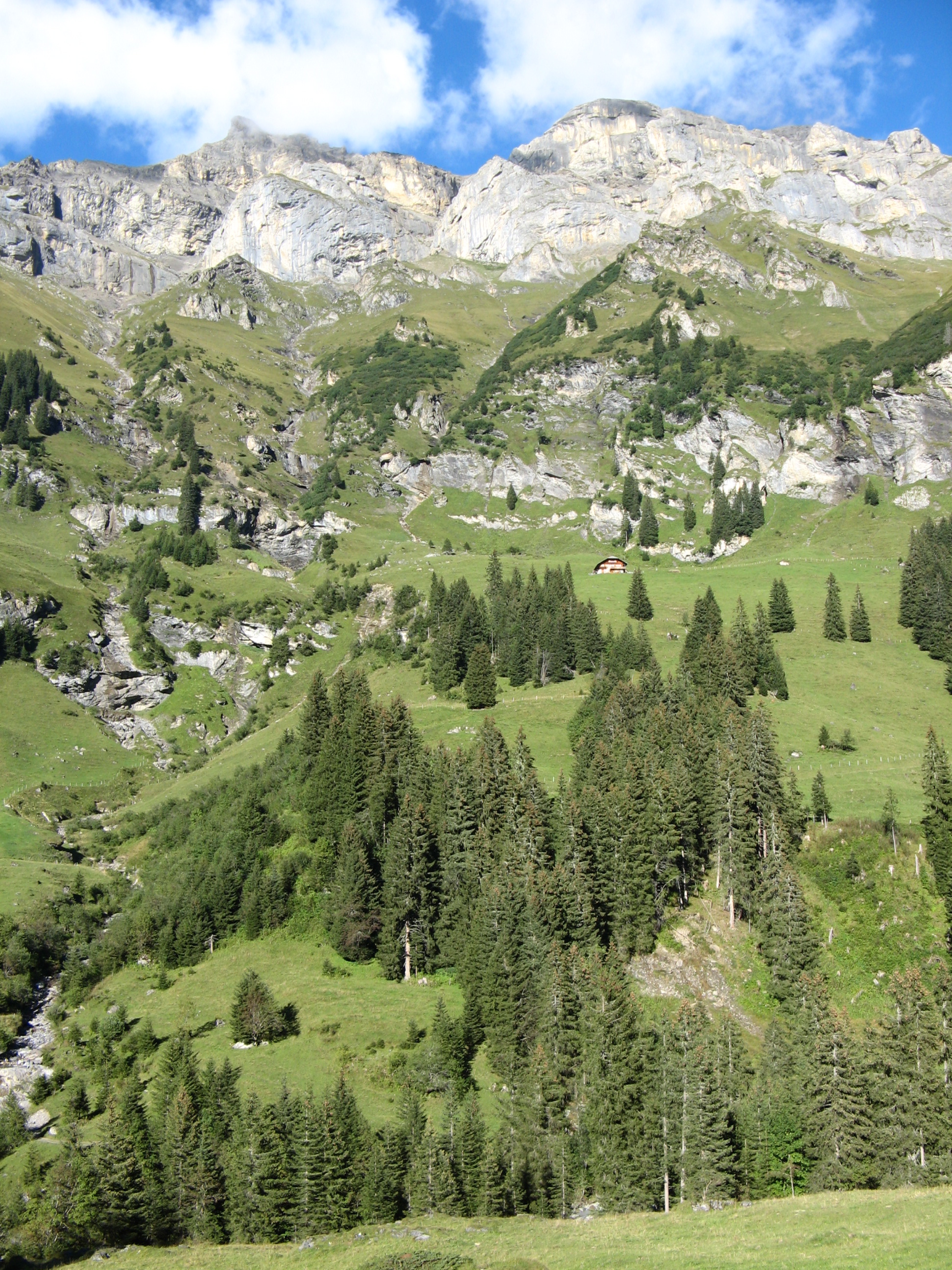
The Alpen, grey ash falls from the glacier. Wind carved rock. Flat stump hills in the foreground, cow bells in the distant sounds. Happy husband with a light lager, drawing. Black face of rock, popped through the firm landscape like a bottle cork from the lips of champagne. The snow faces of the highest alps have direct triangular orders. They climb stacked behind one another in a certain order until they break off at the sky. Green land exists on the top of a wine cork.

(Yes, that is a house on this hill)

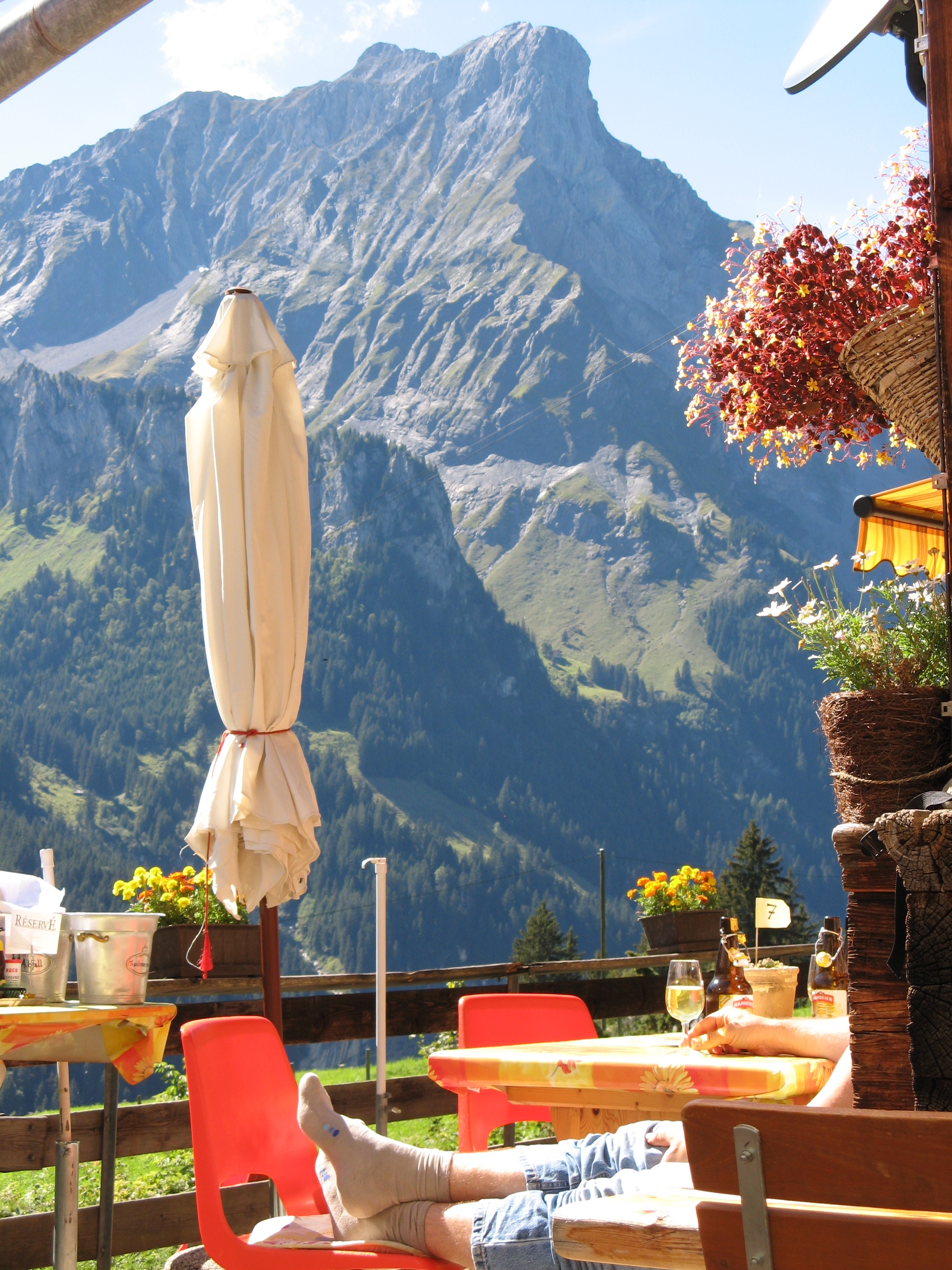
The Suisse positive flag is perched on the slate roof. We left the doll house facades and ceramic tile roofs in Zurich. People are older here, having tall plates of ice cream and cream whipped. Streams in the places where mountains touch glisten and the east faces cast dark cloud shadows. But I am drawing in the sun.

We took a walk before dinner. Phil thinks it is called the Witches Calderon. It took us about an hour to make the loop. We heard the harmony of cow bells and joined their light mood. The sun set on rock I couldn’t take in with my whole being. The mass of the mountain was so large it stood on tip-toes and tilted into me with such great force, that I had to look away.

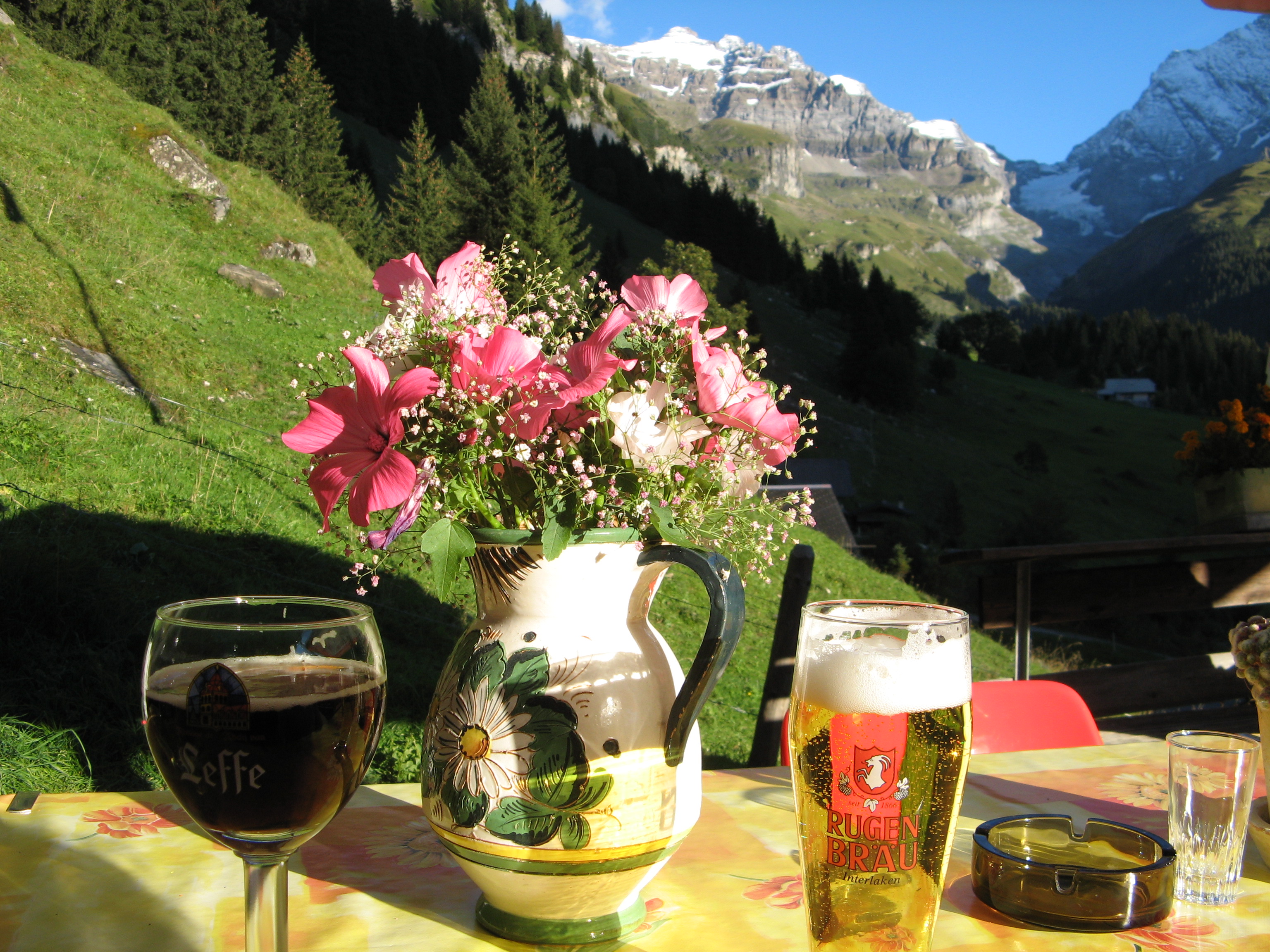
Dinner was served buffet style and we met Bob from Bend who joined us to dine. We ate steaming potatoes, cheese (of course.. and would eat lots of cheese from this moment forward) and a vegetable I’m sure. More than the houses’ guests were gathered on the porch and at some point these 30-something-year-olds took their seat at the table indoors. Perhaps they were here for the weekend, it was a Friday night. Maybe they grew up around the mountains and missed their weight and so had returned. I don’t know but they were still there in the morning when we went to breakfast. We changed out our shoes for house slippers once inside. We brought a head lamp for light -for there wasn’t any electricity. Our room was tiny but we had fresh flowers at our window. We closed the shutters and figured out the locking latch. We slept together on the top bunk of our full-sized bunk beds. Phil wrote post cards and I read Walden.

How did we hear about this Alpine Hike? Backpacker Magazine. On Day 3 you can see a very similar photo I took of Phil to the one I see on that magazine webpage!


Categories
Travel

I want to be more aware.

I want to be more aware. To move forward with this I am proposing to ONLY concentrate on one thing at a time. After a month abroad without an internet / phone attachment to myself, I realize how often I question something and then go directly to looking it up. What a blessing that my questions can be instantly answered! So different from finding time in the next day to go to the library and look through the encyclopedia. (The library culture has really had to change since, right?!)

As a result of wandering, then, directly looking, I see a globalized impact on Italy and her cities. I wonder about myself and the constant distraction this availability provides as I am working on a project or concentrating on daily work -the availability is a distraction. As is, being available.

Along our trip the large plans were taken care of, such as what city we’d be visiting and where we’d be sleeping. But, the day to day time was very loose. So, we judged what was next by the prior ten minutes, and continued on for a month in that way. What needed to be done, or what we desired to do, grew out from the last thing that attended us. We didn’t have to remember to do anything, but did something as it came along.

To be more aware of my trip i am going to write and remember it day by day and give myself the time to be thorough.

Zurich, CH .   Day 1

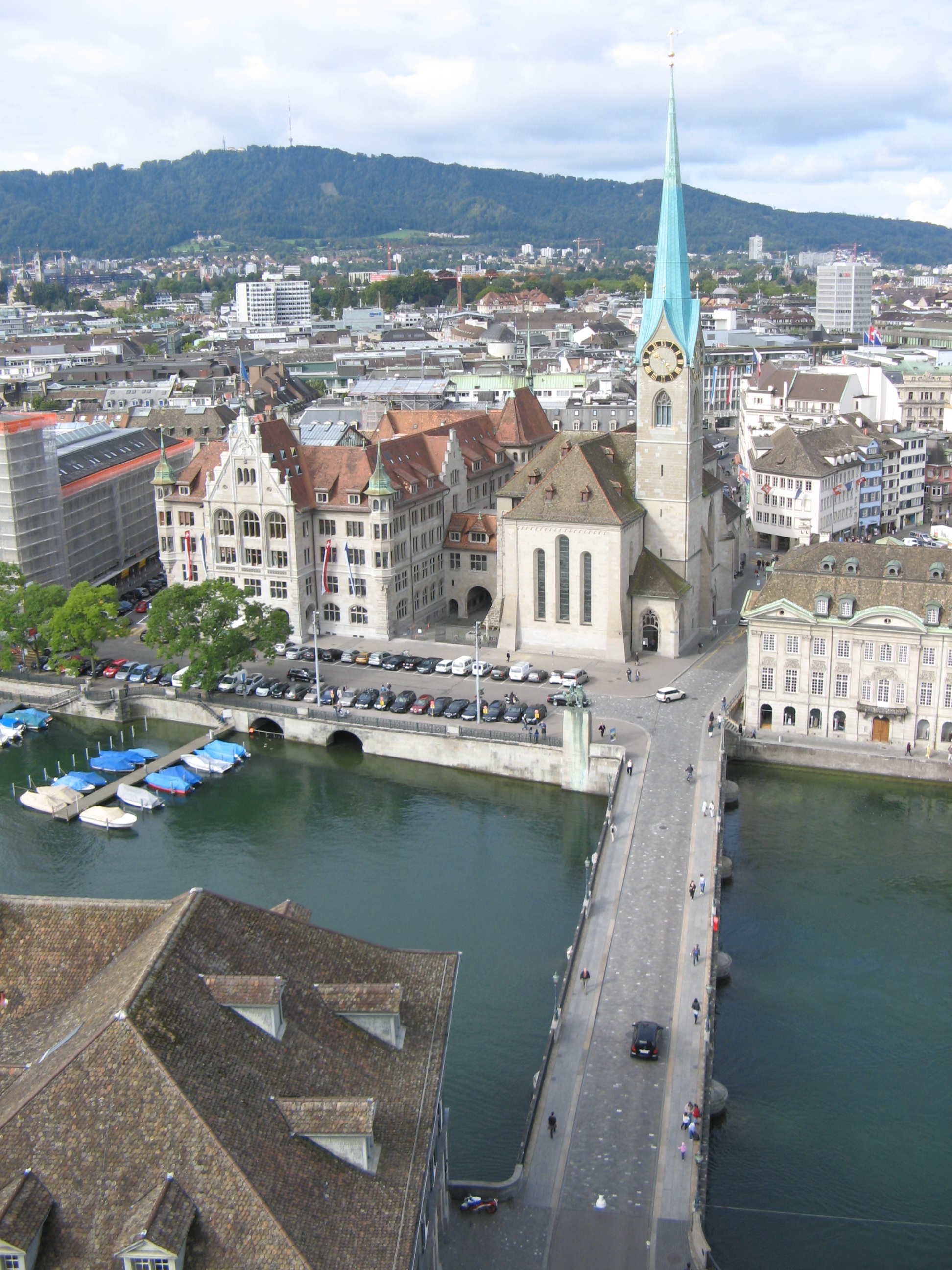
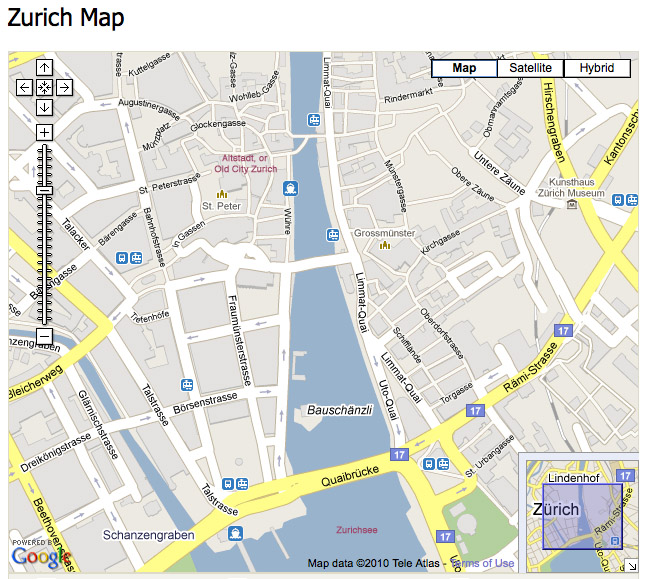
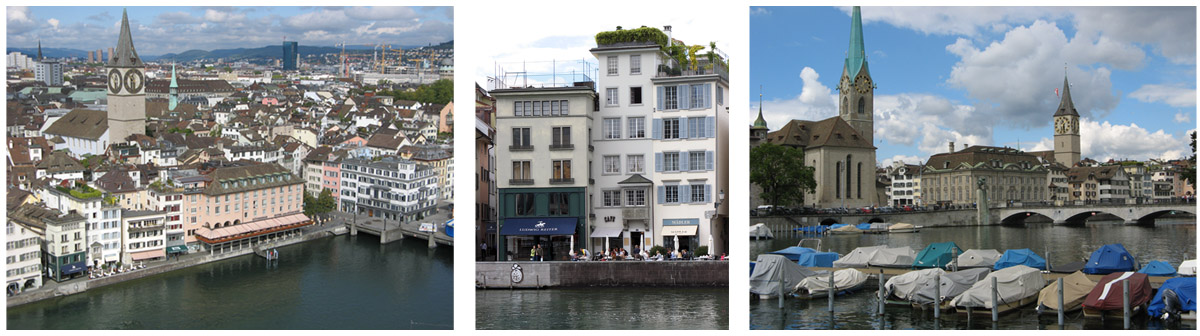
Wandering through the streets of Zurich I see men in suits, bicycle traffic moving along with the street, city rail trains stopping for pedestrians. Zurich was founded for a reason I cannot find beyond that it was enjoyed by lake dwellers. Zurich’s central location probably accounts for one of the reasons it is now the largest city in Switzerland. Now, financial institutions inhabit the city, and on a Friday afternoon bankers and young families are out for a long lunch.

There is the Limmat River cutting through the city, the old town Zurich to the west of it. The river leads to the Zurichsee, the Sea, and a view of Die Alpen. The old city of thin passageways and no cars, people walking between the key maker signs, jewelery shops and sweater stores. One low entrance has green silk curtains to the inside of the door so that upon entering you could close off the door to a window.

Phil climbs the Grossmunster church’s wobbly tower steps while I fall asleep in a back pew. An orchestra is rehearsing in these stone walls, their sound so awake and alive as I drift off.

We stop by the lake. The night concludes in a pink sky, school bands play their trumpets in piazzas around the city. We climb the stepped ten feet wide streets between five-story buildings in the old town to listen and clap with the crowd on the church steps.  We have an Italian dinner by the river, just sit down to be served instead of asking for a table.  The waiters have these compact computers for taking our order with, then someone else bring our drinks out… very efficient. I see a sweater I’d like to get for a friend on our walk home (our mobile home of not more than a bed, a shower and one another for the next month) and think these mountain people know how to dress.  Ladies in at least three layers; tight pants, leggings under dresses with sweaters, jackets and scarves hanging off them as they walk by in heels. Zurich is clean and cool, church bells ring through out the next morning but no one is awake before nine.

Categories
Architecture

Architecture in the Heart of America

Architecture Record’s recent article Hot in Cleveland explains how the heart of the U.S. is still beating.


Also, kudos to Kelly Minner who now writes for Arch Daily! Check her out at

ArchDaily.com

Categories
Travel

Yesterday we were in Milan

We woke up saying that the first morning at home in Ohio. What a trip, I am  thankful we have a long weekend to think about it and settle in before work days on Monday begin.

After living out of a backsack for a month, coming home to many clothes and many chores, I consider the things I want in my life and those things that I should consider doing without. But, it’s great to come home, home to the luxury of friends and family, familiar things, common things you know to enjoy like a bath, a comfortable bed, and the corner coffee shop!

My ultimate vacation day included 4 hours of walking, a few hours of eating and in discussion with Phil, my husband, an hour or two of rest mid-day, and at least an hour to write or draw. All other time awake was left to explore a town, talk a new language, meet new friends and question a different way of life.

I went to Europe with a thought in mind -to question and write about how people spend their time. How do Italians spend their time and enjoy life? I have a stronger grasp on how I enjoy spending leisure time more than I can describe how those people I came into contact with are enjoying their lives.  Most people we met were hosting a great commodity of their local economy, by supporting tourism, serving us countless prosciutto pizza, pesto pastas and vino. Italians were driving busses, manning shops, tabaccerias or news stands. Gentleman behind the espresso bars served strong shots of coffee and liquor. Everyone kept a clean stoop. Women and their daughters hosted new travelers each day in their seven room bed and breakfasts. Women in wine country hosted five couples and small families, cooking four-course means, dinner and dessert. There were culinary boat tours off the coast of Cinque Terre held by a husband and wife team – fishers of tourists they said.

We met a lot of west coasters from the U.S. hiking in the Alps, booking their accommodations each night along the way. We met most people on their 8 week to 6 month travels all the way from around the world -down under in Australia. We had liters of wine on the sun warmed porches late into the night in Menaggio.  Off Lake Como our voices rose until almost two in the morning -two of us from Ohio, Ken from Slough, England, Stephanie from CA, Josh from Australia. We talked of healthcare and taxes, traveling and work, how we most enjoyed spending our days, family and siblings, parents and traditions, growing up and festivals, and when the chef joined us, of families in Napoli.

New people gave dimension to our meaning and thoughts. Walking with Tokeko and her husband through the gorge of the Alps leading to Interlaken, meeting a married couple our parents age over the course of a few days around Cinque Terre peaks, the Australian friends we sat next to at dinner one evening in Siena -he a contractor and she a reader and past flight attendant -we followed one another home to bedrooms that were right next to one another! We met up again a few days later in a different city. Funny how small the world could be, even when we were all moving. Train riders were great -trying to communicate with the older man who called his daughter to try to translate, the fourteen year old school girls (four of them) who were done with school at one o’clock and headed home, who thought we were Australians and then when found out we were from the U.S. assumed we were from N.Y. or Boston.

Along the way I was so fully relaxed and inspired I thought a way of tapping into that up on my return home would be just to go day by day, recalling photographs, video and my journal. Then, with the ability of the Internet now, solve some of my unanswered questions.

So, here we go, two traveling backsacks…

…into the land near where my grandfather’s family is from Giulianova, Province of Teramo, Abruzzo Italy.

Categories
Architecture

Italy, My Secret Garden

Welcome to Italy, my secret garden, iron gate doors, cobblestone courtyards, skinny women in tight black clothes.

In Como… Circling storms around the Duomo covering empty space, tourists with an agenda to experience, supporting Italians working to serve them their pranzo, lunch.

Hot spot candles melt in the dark cathedral. All the people bring in the street and the sky with their shoes. The wax collects as more and more people pray for their diseased. The echoing air cold and colorful by the only light between the clouds. Because it is apart of my unscheduled day.

Bologna, Italy…  We are in the city of vaulted archways, a city of hallways and interior courtyard lives. The porticos, for which the city is famous are pedestrian covers from the rain and sun.

Students in this ancient city commune in the few piazzas for a Friday evening to defend their scientific thoughts.

Today we may climb the 4 kilometer portico of San Lucca. It is near the Italian Football stadium.

Across Italy, and most prominent in Padova Italy where the students are, there is a fashion crisis jumping back to the 80,s! American T-shirts, tight black, green, turquoise Jordache jeans ending with their very popular Nike tennis shoes. Tennis shoes that are hot pink, orange and blue. Away from those pegged pants are the Bologna dressers. Dressers dressed in vacation, buttoned up linnen dresses, scarves and pretty sweaters. I read Walden under a lunch portico, below an old and crumbling brick sidewalk and watch the city of peole for an hour.

Categories
About Me

In Italia Now

Its good to be mixed in with other cultures

elbow rubbing with people who believe in siesta

and a different pace of life.

Society has a way of engulfing the nature of my actions.

I find myself enveloped in walking without a purpose in Italy

but remember finding it difficult to sleep in, in Ohio.

There are saturated people and buildings today in Como,

our first day in Italy. Streets are flooding near lake Como.

My husband and I are confined together under an umbrella we bought.

Only when we sit for paninis at a cafe or walk into the Duomo are we apart.

We are spending our time in the new places being aware and loving one another.

Walking, seeking, questioning, writing and acknowledging what we see and each other.

Being creative by drawing, filming and photography. Some days we physically challenge ourselves to cross mountain saddles, hike long distances and earn the views to which we rest at with great leisure, because of the endurance.

We address time with no concern but for curiosity and compare what it means to the people and places we visit.

I feel at home and at rest in Italy. I have the Adriatic Sea in my blood and it is here that I feel right and confident, relaxed and in love.

My husband appreciates this.

Even though a barrier of language exists the puzzle is a wonderous maze that seems childlike and fun with its mystery.

Even stepping from Switzerland to Italy was unannounced and seemed to pass too easily for the two of us. No one asked who we were, just directed us with sign language to follow the chained walk way, past border control offices that sat vacant.

It is a rebirth, but if only in spirit, to be here.

Categories
Poetry

Tsy Architekts en Die Alpen

Two Architects in the Alpen.

To the Alpen

Flying kisses over a black sea

the german children wake up to

church bells tolling for the long hour between

orchestras rehearsing in the tall stone walls

built up into the Zurich sky.

.

The Aplen opens form the clearing clouds

we climb steps to sit with the Suisse and clap

for the school bands play in the streets their long triumphs

.

Rounded the earth and met the sun

 a new moon in the vertical spruce forest

slippery roots and large slugs

soapstone roads up to the saddle.

Perineal waterfalls after the heavy rains

cascade into the gorge from 1000 meters.

The river becomes a lake trapped by rock

a mirror to the snow-capped secrets that hide the stars.

.

Wind carved rock, creamy white rivers

waterfalls deep in the bellows of a mountain

climb like ants carrying their weight

on the shoulder of the ridge, towns are built

with views into the face of an onlooker.

.

Well marked paths from Griesalp, Steinberg, Murren

to Gimmewald cross barn porches, beneath low slung roofs

chalet with rounded stacked wood

 four-year old blonde children gathering pine dust,

flat sump hills in the background.

.

Cow bells like plunking stones in a shallow river

hollow hills with windy skies

pine cones playing harmonic tunes thumping hollow ground

wind chimes swirling light melodies

soft sounds of the hills.

.

The direct triangular orders of The Alpen turn with each hour

a shallow spine falls 1000 ft or more on it’s underbelly.

Round the mountain curve, sunken forest paths

grass planes with small rock gravel collected by many hikers into man-made streams of way finding.

A floral ski town quiet in the September rain.

.

Spoon and bowl cupped in the mountain crown

the slanted stance of spruce held in the upraised heavens of granite rock.

Slowly stopped water dripping into rock holes

easy to live between, easy to be disoriented.

Holland hands grasp circles and surround the base of Mt. Eiger

from Griendelwald are the plains that slowly rise

to make mountains where lesser known glaciers

have come before the gorge formed

a slowly paused ocean.