Categories
Book Review

Books and Podcasts for Writers

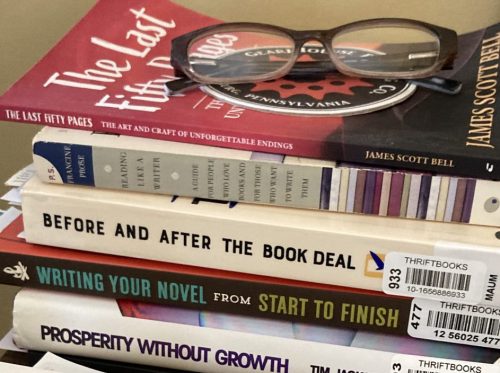
Two Podcasts and three Books continue to have the most significant impact on my writing.


Fiction Writing Made Easy by Savannah Gilbo
The Shit No One Tells You About Writing by CeCe L., Bianca M, Carly W.
Reading Like a Writer by Francine Prose
The Last 50 Pages by James Scott Bell
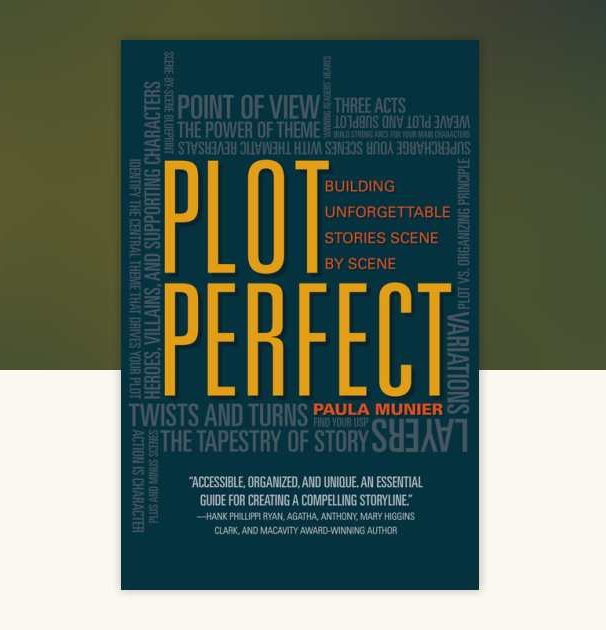
Plot Perfect by Paula Munier

Savannah Gilbo’s podcast, webinars, and free resources have incredible tips and organizing strategies. TSNOTYAW gives you an inside look at how literary agents find stories. I listen to 90% of the episodes, and in the case of Savannah Gilbo’s short-and-sweet sessions, I have listened to them again and again as I go through different phases of a manuscript.
Prose’s book, Reading Like a Writer, is a book I’ve never stopped reading. Once I finish it, I begin it again. I can put it down and pick it up anytime, anywhere, no matter if I’m in the middle of her chapters about paragraphs or a chapter about sentences. Every word in her book is a gem.
The last two books by Bell and Munier have guided me to start and to finish my book with the best advice.

Categories
Book Review

The Recipe for Writing a Book

Start with a problem

Throw in an oddly acting character

Squeeze the character in a difficult place

Layout the plot

Chop through the scenes

Read

Write

Edit on repeat

Find the right-sized critique partner

Bake

Critique partners establish accountability, and a student who wants to develop a novel from the stories he told his cousins as a child is the perfect accountability partner. Last year, we met weekly for two semesters to go chapter by chapter through Paula Munier’s Plot Perfect: How to Build Unforgettable Stories Scene by Scene, and strengthened our manuscripts. I wrote THE ARCONE and learned how to write a book. To plot out a second book, I started with Munier’s PLOT PERFECT, and found the magic of making something better the second time around. 

Categories
Book Review

Beta Readers

Beta Readers of THE ARCONE have been people who like historical fiction, who seek out 19th-century Florence literature, and architecture lovers. Some are friends, some are writers who have become friends. The earliest reviewers read the manuscript with its plot holes and unbalanced story arcs. (But, they read the book to the end! Thank you!) Their comments enhanced my characters, making Vincenzo and Lilli come to life on the page and feel more like people I’d want to get to know. Without their encouragement, finishing the project would have been difficult.
How can you find the person who might choose your book off the library shelf? I explored Scribophile and considered The Spun Yarn. Finding the right reader is challenging. Oftentimes, I’ve exchanged reading and reviewing my work with other writers in the editing stages, too. Writers come to the table engaged, ready to hear how someone else has interpreted the work.
Close friends and family have been the most supportive readers—they know they can be honest. They came to my work with the best of intentions. I so appreciate their time, given how many other great published books there are to read.

Categories
Book Review

Literary Agent Submissions

THE ARCONE is the first novel I’ve written, and using QueryTracker to find literary agents open to historical fiction submissions has been a positive experience overall. I researched and submitted query letters to sixty agents, and only one asked for my manuscript. (It was then declined.) So, either my manuscript needs work, or I’m trying to drive a hole-in-one in the dark. Maybe it’s a little of both. However, I found the QueryTracker website critical to finding the right agents and organizing the submission process. Agents are found by genre, the firm they work for, and whether they are open for submissions. Emails, websites, and preferred submission style information are all included. I told myself I’d submit to at least forty agents, and then consider a hybrid or self-publishing alternative to traditional publishing. After attending conferences and meeting publishing professionals who gave me a glimpse of their world, I think I’ll just be patient. I can write another book while I wait and continue perfecting a craft.

Categories
Book Review

Have a Story to Tell?

Fairmont State generously supported a sabbatical, allowing me to complete a manuscript for my book, THE ARCONE. I learned how to edit, query literary agents, rely on my writing critique partners, and, finally, how to pitch to an agent. Through recommended books and blogs, I know so much more about the writing-to-publishing journey, even if I haven’t landed an agent yet. One friend called this collection of experiences a “punch card” MFA.
I had a great experience in November with ProWritingAid’s NovNov event, which encourages you to write a novel in one month with the support of many people around the globe. I learned that the silent writing groups held me accountable during times I would have otherwise wasted.
If you have a story to tell, take twenty minutes or two hours, sit down, give yourself the time to focus, and then write.

Subscribe to receive a plan drawing related to my book. The drawing recreates the Jewish Ghetto that existed in historic Florence, Italy.

Categories
Book Review

Book Signing

The Morgantown Writers Group (MWG) will host a book signing at Barnes & Noble today, November 24th, from 1-4. Check out our website here to learn more about the group and our book, River and Stone, the anthology collection edited by Melissa Reynolds and Patty Hopper Patteson.

Categories
Book Review Poetry

Breathing Poetry

carlow.edu

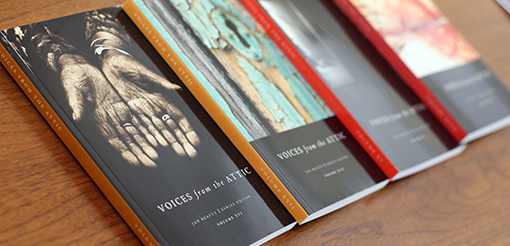
This past fall I participated in a Madwomen in the Attic Workshop led by local Morgantown poet, Lori Wilson. The class of five women, including Lori, provided an intimate setting in which I felt comfortable reading raw work in an effort to produce better poetry. The class also made me focus on writing. Lori’s insightful comments have continued to echo in my thoughts while I rework many of the poems presented in class. Last year I read Poetry for Dummies for the first time, which gives additional suggestions for inspiration and refining poetry. I thought I’d share a few examples from it below.

poetry for dummies

I’m finding these exercises below very helpful:

Chapter 9 – Going for the Breath: Framing individual lines

As you read poetry you become sensitive to the way you breathe. You read a group of words and then pause before reading another group of words -it’s just natural. Pay attention to that when you write poetry as well. Let those natural pauses determine where lines end. The breath, as it’s called in the poetry world, is a natural way to frame individual lines. -pg 162

My poem went from this:

To this:

Chapter 10 – Working with Traditional Forms of Verse : Traditional Ballads

Ballads take many forms. A popular one is the four-line stanza in which the first and third lines are written in iambic tetrameter (four iambs) and the second and fourth are written in iambic trimeter (three iambs), with a rhyme scheme of ABXB (the third line, X, need not rhyme or may rhyme with A).

Here’s what two such stanzas may sound like:

The winter moon had tipped and spilled
Its shadows on the lawn
When Farmer Owen woke to find
His only daughter gone;

She’d taken all the clothes she had
Against the biting cold,
A
nd in a note to him she wrote,
“I’ve taken all your gold.”

pg 170

Chapter 10 – Sonnets

  • It must consist of 14 lines.

  • It must be written in iambic pentameter (duh-DUH-duh-DUH-duh-DUH-duh-DUH-duh-DUH).

  • It must be written in one of various standard rhyme schemes.

If you’re writing the most familiar kind of sonnet, the Shakespearean, the rhyme scheme is this:

A
B
A
B

C
D
C
D

E
F
E
F

G
G

Every A rhymes with every A, every B rhymes with every B, and so forth. You’ll notice this type of sonnet consists of three quatrains (that is, four consecutive lines of verse that make up a stanza or division of lines in a poem) and one couplet (two consecutive rhyming lines of verse).

Ah, but there’s more to a sonnet than just the structure of it. A sonnet is also an argument — it builds up a certain way. And how it builds up is related to its metaphors and how it moves from one metaphor to the next. In a Shakespearean sonnet, the argument builds up like this:

  • First quatrain: An exposition of the main theme and main metaphor.

  • Second quatrain: Theme and metaphor extended or complicated; often, some imaginative example is given.

  • Third quatrain: Peripeteia (a twist or conflict), often introduced by a “but” (very often leading off the ninth line).

  • Couplet: Summarizes and leaves the reader with a new, concluding image.

    pg 172

    .

Chapter 11 – Writing exercises for Poets pg 184-185

1. Using language from one subject to write about another. (By Bernadette Mayer)

2. Hiding half of your poem from sight. Take one of your poems and fold it in half horizontally, so you can see the top half of the poem but not the bottom half. Rewrite the half you can’t see- without looking at the original. Compare the original to you revisions. (By Maxine Chernoff)

3. Reworking poems you don’t like. Select one of your poems that you’re dissatisfied with. Read it through. Now put it away. Try to write the same poem again without referring to the older version. (By Maxine Chernoff)
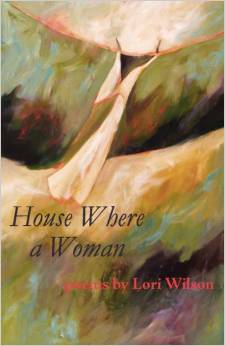
 

house where a woman

Check out Lori’s work, and join the Madwomen in the Attic local class as we host Mary Lucille DeBerry in the celebration of her new book. Hope to see you next Saturday, at 2:00 on January 10th at the MAC in Morgantown, WV.

MaryLDebPosterFinal

Categories
Book Review Poetry

Poetry for Dummies

swirls

I’m currently reading Poetry for Dummies published in 2001 and have given myself Saturday afternoon homework.

poetry for dummies

In the middle of chapter 9, a chapter describing Open-Form poetry, there is a great open verse tutorial. I’ve found it online as well at the Dummies website too and have copied it below.

Think of open-form poetry as a way of thinking — an especially intense awareness of every single aspect of the poem, from subject and tone to music and rhythm, from the physical shape of the poem to the length (in space and in time) of the lines, from the grammar you use to the parts of speech.

When you write an open-form poem, try to be very conscious. Everything in the poem, every feature, every aspect, must have a reason for being there. Be conscious of the following:

  • Economy. Cram as much energy as possible into each word. Cut everything that doesn’t absolutely need to be there.
  • Grammar and syntax. Are you always using complete sentences? Well, that’s fine — but you could also do it another way. Decide whether you have a reason to write in complete sentences for this poem. If you can come up with a reason, fine. If not, consider alternatives — bursts of words, single words, word fragments. And who says you have to use “proper” grammar? Or punctuation? Try breaking a few rules, if that improves the poem.
  • Parts of speech. Some teachers say you shouldn’t use adjectives or adverbs; they prefer nouns and verbs instead. That’s an excellent starting point: Use only the words you need. If all you’re doing is prettifying something, forget it. Use adjectives only when they’re surprising (“your green voice”), contradictory (“aggressive modesty”), or give information the reader simply can’t get elsewhere (“It was a Welsh ferret” — how else would we know a ferret was Welsh?).
  • Rhythms. Look at the rhythms in your lines. Does the rhythm of the line contribute to its meaning? Anything sing-songy? If so, is it good that it’s sing-songy?Often, open-form verse falls into iambs (a group of syllables consisting of an unstressed syllable followed by a stressed syllable, as in “alas!”) and dactyls (one stressed syllable followed by two unstressed, as in “penetrate”). Don’t let this happen unless there is a reason for it.
  • The physical lengths (the number syllables and the actual length) of the lines you use. Avoid falling into exactly the same lengths. Every length should have a reason behind it.
  • The length (in time) it takes to read each line aloud. If each line takes about the same number of seconds, figure out whether there’s a reason for it. If there isn’t, consider other shapes and lengths.
  • Line endings. Poets realize that line endings carry a certain emphasis or pressure. Your lines should end where they end for some reason. The way a line ends — where, and after what word or punctuation mark — should be the best way to end. Do you want a pause there? What’s going to happen when your readers go to the next line? Something unexpected? Some surprise?Read a lot of open-form verse, and you’ll notice that poets use a great deal of enjambment, winding the words around the ends of lines in gorgeous and meaningful ways.

I have so many half-formed poems that need to be worked on. I brought one of them to the table with me and tried to think of its’ form and consider it in the light of each of the bullet points above.

My poem went from this:

The Rush of Wings

.

Each day that passed she fell in order with living

The resonance of time, individual

The light of the sun

Counted on

.

The rush of wings

Shook loose the snow

Buried on top of the earth

.

Dreams of her mother

Visited at night

Awaking other thoughts that had been lost

friends,

taking care of yourself,

cleaning the closets,

using glasses from the cupboard,

time alone

.

When quietness had come.

To this:

The Rush of Wings

.

Death is a gaping hole

A limp lived with

In the wake of a loss

Someone is left alone

.

Each day passed

Living fell in order

Time, individual

Half-paralyzed

The movement of the sun

Counted on

My grandmother smiled.

.

The rush of wings

Shook loose the snow

Buried in the earth

.

Dreams of her mother

Visited at night

Awakening lost thoughts

Friends

Taking care of yourself

Cleaning the closets

Using glasses from the cupboard

Time alone

.

When quietness had come.

~

Other quotes I’ve picked up in my reading are below:

More meaning, fewer words. pg 10

Use vowels, consonants, sounds as a rhythm to the music of your poetry. pg 69

An intricate braid of poems. pg 103

Let the natural poem breath make the line break. pg 163

One thing I don’t do very often with my poetry is to speak it aloud. Joining a writers group allows this verbalization, which in turn informs my poetry by the way I hear myself and the way others describe understanding my poems.

(I liked the grassy swirls on the first image above. I took this at Phipps Conservatory.)
Categories
Architecture Book Review

Architecture Forces

I immediately had to agree with Mr. Hawthorne! While reading through Taking the Pulse of Architecture (By Christopher Hawthorne for Architectural Record) I underlined the following sentence: The two most disruptive forces to hit the profession in decades: the digital revolution on one hand and the global economic crisis on the other.

The 2012 version,  {of the Venice Architecture Biennale} running until November 25 and anchored by a thoughtful, beautifully crafted, and rather cautious main show by the 58-year-old British architect David Chipperfield, is no exception. It reveals in almost painfully honest terms the clashing ways that architects are reacting to the two most disruptive forces to hit the profession in decades: the digital revolution on one hand and the global economic crisis on the other.

Then, I had to write about it myself.

Two influences on Architecture today:

the digital revolution and an economic crisis.

~ Part 1 – The Economic Crisis

There are problems with the profession of Architecture. In a production-induced environment creativity comes second to a quick project. The products we build with, the environment we build in, and the schedules we work around are binding. Construction itself is cost prohibitive. We are value-engineering ourselves out of work. This is an economic crisis within an economy that has tried to grow too quickly. Lending money to house every willing individual created a sinkhole in 2008, when banks needed a bailout to survive. The money problem is grand. But within it I’m still, luckily, working in a small architecture firm. As an architect not only do I have to fashion the way materials come together, but I have to be creative with how my client will afford the architecture. This process requires foresight just as much as buildings do.

The price to build hasn’t changed and neither have the means to complete one. This translates into proposed projects my clients cannot afford. I must find a creative solution to advance their plans. So, I must move beyond the drawing table to initiate thinking of an economic model for architecture. I can design and build, keeping the sensitivity of design and cost by developing localized responsibility on nearby resources. The role of architect expands to encompass being a “program” worker, a cost estimator, and a magician with new materials to shelter societies needs in an affordable way.

Architects have different ways of managing budgets while getting projects built.  Susanna Sirefman’s book ‘Modern Shoestring’ discusses building with inexpensive materials much like Jill Herbers’ book ‘PreFab Modern’.  Herbers’ book suggests using readily available materials to cut costs. Steel, glass and aluminum are suggested materials that can be found in abundance. This is confirmed in the new use for old shipping containers. These steel boxes are sliced to fit windows and doors within a houses’ program of spaces. The structural blocks have been stacked, embed in the earth, and cantilevered from sites to form creative solutions to house our fascination of how to shelter ourselves.

‘Building around bargain basement windows, Sirefman describes, is an inexpensive solution to providing windows where sunlight is needed. Using recognizable materials in new ways can provide a sustainable reuse of items that may have been discarded. Specific applications for materials may also be selected for inherent qualities in the material to create insulated, solar, off-the-grid homes that provide comfortable houses without the over dependence on nonrenewable energy. The well-worn materials can be used to their best purpose. Herbers’ book describes a case study on five homes. These homes, Ikea Blokok House, Graves’s Target House, Holl’s Turbulence House, D. Hentz’s Venice Ca ‘Concrete House’, Susi and Fred Houses by KFN Architects, and J. Siegals Office of Mobile Design are built examples that push creative ideas for practical applications. Herbers’ book offers ‘advice on new materials and processes’ with these examples (as I read in a recent review here.)

Cost-Effective Building, a book edited by Christian Schittich is another book that markets building to ‘create unique architectural solutions with small budgets.’  Within a book review on A Daily Dose of Architecture, the author simplifies the summary of the solution as ‘simplified structures and volume affords more (envelope) detail.’ A comment on the post responds that ‘repeating non-planar, inexpensive elements you begin to see non-orthogonal buildings constructed cheaply.’

Sirefman offers a third solution in the budget versus architecture balance to be the selection of the construction team. ‘Perhaps the client can offer his hand, an undergraduate class is available for a learning session, or a less expensive contractor may sometimes be found.’ Though, I would imagine this ‘cheap labor’ is something that cannot be shopped for so easily. Some contractors bill labor and material directly to the customer. Other contracting firms mark-up the materials on top of the labor costs. Just as every site and client differs, so do the ways in which to get creative with a budget.

Stephen Crafti, in his book Affordable Architecture suggests a focus on the planning phases. Architects take on the role of a psychologist, or a life organizer, related to the structure that surrounds your living. ‘Strong ideas are more valuable than unlimited budgets.’ He says. With a focus on ‘short term and long-term costs, program shrinkages, and on what the client needs versus what they ‘want’ a realistic plan can be pulled out. It takes an architect that is well versed in bargaining and thoughtful solutions from the onset. The architect must stand on the side of the budget for their client, so that in the end a project is constructible.

Perhaps architects should work harder at finding materials to build with in the beginning. If I don’t want to be shocked with the sticker price as bids come in, I shop, collect, and find solutions within materials already accumulated. Materials architects may find at their disposal can found in antique shops such as those I’ve found in Pittsburgh at the end of this article.

The solutions begin to repeat the same mantra, materials and labor, materials, labor, and an architects’ expertise is challenged and celebrated in the way they choose to work with both to their advantage.

Architectural Emporium, Adams Ave. in Canonsburg Pa

TriState Antiques in Canonsburgh Pa

Construction Junction, Lexington Ave., Pittsburgh

Final Authority Antiques 2358 Penn Avenue Pittsburgh, PA 15222  (412) 281-1488

Mahla & Co Antiques – 17th & Smallman Street, Pittsburgh, PA 15222 (412) 471-2090

Zenith Antiques – 86 South 26th Street Pittsburgh, PA 15203   (412) 481-4833 

Who’s New 5156 Butler Street Pittsburgh, PA

MatthuPlacek_ArchRecord

~ See the plywood ceilings Above ? ~

Parish-Art-Museum-ArchRecord_Roland_Halbe

After writing the article above, I’ve found numerous publications siting how Architects can budget with materials. For example:  Use cheap and recycled materials! by Parrish Art Museum by Herzon & de Meuron

To keep costs down, Mergenthaler used the pocked and craggy concrete that covers the museum’s long exterior sides after seeing similarly rough walls in a local basement. The scruffy character of the mottled concrete keeps the vast expanses from looking monotonous. “The thing that you really engage with first has to have a presence, a solidity, and a character,” says Mergenthaler. “It’s not just cladding.”  – Article in Architecture Record by William Hanley

Categories
Book Review

Reading and Reflection

There’s nothing like a well written book to give me a full dose of inspiration. I return to Francine Prose’s book Reading Like a Writer every few years to remind myself again to read slower, seek classic writers, and be more perceptive in the life that surrounds me. Francine Prose

In the last month I’ve let go of my leadership role in a local book club to focus on books I’ve wanted to read for years. This year I’ll be focusing on reading work to inspire my writing and architecture work.

So, to the Happy New Year I go.

My bookshelves are stocked with the following books:

Oliver Twist by Charles Dickens

The Adventures of Huckleberry Finn by Mark Twain

Threshold by Shirley Kaufman

Molly MCBean and the Secret Cave by Joanie Murray

Blaise Cendrars Complete Poems

Green-Silver and Silent Poems by Marc Harshman

Complexity and Contradiction by Robert Venturi

American Wife by Curtis Sittenfeld

The Paris Wife by Paula McLain

All thatFeeds Us by Marc Harshman

Virginia Woolf’s essay on Being Ill

The Lacuna by Barbara Kinsolver

A Land More Kind than Home by Wiley Cash

Into Thin Air by Jon Krakauer

Professional Practice: Architects

Reveal by Studio Gang Architects

Virginia Woolf: An Inner Life by Julia Briggs

Chuck Dugan is AWOL: By Eric Chase Anderson

Specimen Days by Michael Cunningham

Sample: 100 Fashion Designers (Phaidon Press)

Land of Love and Drowning by T. Vanique

The French House by Don Wallace

The Victorian City by Justin Flanders

The Vacationers by Emma Straub

One Plus One by Jojo Moyes

Thinking Architecture by Peter Zumthor

Cusp: Poems by Jennifer Grotz

David Adjaye: Making Public Buildings by Peter Allison

David Adjaye: Houses; Recycling, Reconfiguring, Rebuilding by Peter Allison

Local Journeys Poems by Marc Harshman

Joseph Albers: To Open Eyes

A Writer’s Reference by Diana Hacker

The Sense of Order by E H Gombrich

Brideshead Revisited by Evelyn Waugh

The Face of North America by Peter Farb

The Dream of Earth by Thomas Berry

Signs and Seasons by John Burroughs

Crime and Punishment by Fyodor Dostoyevsky

The Great Gatsby by F.Scott Fitzgerald

The Grapes of Wrath by John Steinbeck

Animal Farm by George Orwell

To Kill a Mockingbird by Harper Lee

A Jury of Her Peers by Elaine Showalter

Where I’m calling From: New and Selected Stories by Raymond Carver

American Pastoral by Philip Roth

The Odyssey Translated by Robert Fagles

Sappho: A new Version by Willis Barrstore

Beowulf translated by Seamus Heaney

Hafez and Rumi (Khajyam and Ghalib)

The Sonnets by W. Shakespeare

Dante: The Divine Comedy, The infernno of Dante by R. Pinskey

Pacific and Other Stories by Mark Helprin

As I Lay Dying and Light in August by William Faulkner

Dorian Gray by Oscar Wilde

A Portrait of Dorian Gray by Karl Lagerfeld

She Walks in Beauty, Caroline Kennedy on Poetry

Blonde by Joyce Carol Oates

Wuthering Heights by Emily Bronte

Jane Eyre by Charlotte Bronte

Wise Blood by Flannery O’Connor

Mary Oliver’s New and Selected Poems

Noose and Hook by Lynn Emanuel

a gathering of matter a matter of gathering by Dawn Lundy Martin

Finding Beauty in a Broken World by Terry Tempest Williams

Figure Studies by Claudia Emerson

The Last American Man by Elizabeth Gilbert

The Sea Around Us by Rachel Carson

Frank Delaney’s Ireland

All Quiet on the Western Front by Enrich Maria Remarque

Blood, Bones, and Butter by Gabrielle Hamilton

.

That should be enough to get me through winter, right?