.
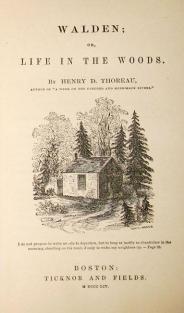
I have noticed that Walden, by Henry D. Thoreau is frequently referenced in news media. Architectural Record has mentioned the book at least three times in different issues through out the last year (Robert Ivy, Cabin in the Woods, and a recent Record Homes issue), ‘The Happiness Project’ by Gretchen Rubin mentions it and I’ve read reference to Thoreau’s time in the woods in House Beautiful Magazine too. In different accounts of finding your own spirit, the humbleness in building one’s own house, and in the action of filling out the creases, finding your own character, Walden represents an acute account of the life that surrounded Thoreau while in the forest.
He writes, ‘The earth is not a mere fragment of dead history… -not a fossil earth, but a living earth; compared with whose great central life all animal and vegetable life is merely parasitic.’ ‘You may melt your metals and cast them into the most beautiful moulds you can; they will never excite me like the forms which this molten earth flows out into.’ (From the chapter Spring p334-335 in the Edition by Yale Press 2004.)
For two years, two months, and two days, time did not matter. What did was instinct. Thoreau moved to the forest around Walden Pond July of 1845. Having built his home that spring, March 1845, at the age of 27. He farmed beans, made loaves of bread, bathed in Walden, and perceived life in the forest. He built a chimney before winter. He watched the lake and measured the boundaries. Discovered ice and placid waters for looking to the bottom. He marveled at the colors of fish, at perfect round stone temples at the bottom of Walden lake and witnessed a fearless battle of the red ant versus the black ant nation. He spoke heroically of their manners and watched the black ant win (all other red ants around him had died), and then leave without antennas and with crippled legs.
165 years later his accounts of society and tradition are still pertinent if not more so complicated and diffused. He moved to the forest to ‘transact some private business with the fewest obstacles.’
Thoreau’s book begins with the chapter titled Economy. He describes philosophy, luxury, and the toll of ownership. ‘I see young men, my towns men, whose misfortune it is to have inherited farms, houses, barns, cattle and farming tools; for these are more easily acquired than got rid of.’ p3 ‘What is the nature of luxury which innervades and destroys nations? p14
I began to read Walden during the travels of a month-long honeymoon. This is what I wrote upon reading the first few pages. It is here that I am seven days into spending time as I wish. Fulfilling my days with challenging hikes, reading and writing to reflect. Drawing and learning to color. Challenging myself to keep track of the mountains and relate them in drawings. My husband draws the landscape. We eat and drink often. Time doesn’t matter. We are aware of our few belongings and are taking better care of them and one another. I think I own too much at home to myself to take care, and do not work as apart of my community or neighborhood to feel kinship or pride to stand together.
What society celebrates as success is a form of acquiring methods to bind your freedom. When you own land, a house, manage a family and animals, crops, or when you become a vice president, receive position on an authority board, -people, buildings and organizations depend on your opinion and presence. Late in Thoreau’s book he describes a man being appointed to town duty, -how he may not take vacation… because of his commitment.
I wrote a poem about success while reading the book.
Success
Is success in your picture
the recognition of your face?
.
Is it all you accomplish in your week,
do you remember?
.
Is it the parties, champagne
and fine toasts?
Is success quiet or loud?
.
Is success praise and good doing?
Is it alone or together?
.
Can you define it with
metals, trophies, or certificates?
.
Is it a glitter ball signifying
the turn of a new year?
Is it what we wear
to define our character?
.
Is it found in hard formulas
or in the last line of poetry?
.
Is it the wrinkles on a face
or the exhaustion in your voice?
.
Is it a word at all that can be defined to
so specifically a cause,
.
a word to describe
survival or wealth?
.
Does happiness have a place
within its parameters?
.
Do you remember what
you are chasing, who
you are and where you
are going?
.
Has success been a
purpose for going?
A path and direction
for finding yourself?
.
Thoreau writes
‘The life which men praise and regard as successful is but one kind. Why should we exaggerate any one kind at the expense of others?
If I were to define my purpose under the influence of Thoreau I would say that the point of life is to keep up ourselves without running debt and reach for the heavens.
Thoreau writes that he went to the forest to ‘transact some private business with the fewest obstacles.’ The fewest expectations, the fewest interruptions, -a living forest and lake that ask nothing of you, -just that you live with them. In the chapter Pond In The Winter (p314-315) Thoreau describes the laws to which he found he was part of in the forest. ‘If we knew all the laws of Nature, we should need only one fact, or the description of one actual phenomenon, to infer all the particular results at that point. Now we know only a few laws, and our result is vitiated, not, of course, by any confusion or irregularity in Nature, but by our ignorance of essential elements in the calculation. Our notions of law and harmony are commonly confined to those instances which we detect; but the harmony which results from a far greater number of seemingly conflicting ,but really concurring, laws, which we have not detected, is still more wonderful. The particular laws are as our points of view, as, to the traveller, a mountain outline varies with every stop, and it has an infinite number of profiles, though absolutely but one form. Even when cleft or bored through it is not comprehended in its entireness.’
Thoreau describes society. p147 ‘Society is commonly too cheap. We must meet at very short intervals, not having had time to acquire any new value for each other. We meet at three meals a day and give each other a new taste of that old musty cheese that we are.’ (That made me laugh.) We have had to agree on a certain set of rules, called etiquette and politeness, to make this frequent meeting tolerable and that we need not come to open war.’ ‘Certainly less frequency would suffice for all important and hearty communications.’
‘What sort of space is that which separates a man from his fellows and makes him solitary? I have found that no exertions of the legs can bring two minds much nearer to one another.’ p144
(I think this is comical too.)
‘It is a ridiculous demand which England and America make, that you shall speak so that they can understand you. Neither men nor toad-stools grow so… As if there were safety in stupidity alone… The words that express our faith and piety are not definite; yet they are significant and fragrant like frankincense to superior natures. Why level downward to our dullest perception always, and praise that as common sense? The commonest sense is the sense of men asleep, which they express by snoring.’ p352-353 He asks men to ‘soar but a little higher in our intellectual flights than the columns daily in the newspaper.’ p115
Silence plays a large role in securing the availability of Thoreau’s thoughts. He would spend his day… ‘After hoeing or perhaps reading and writing in the forenoon, I usually bathed again in the pond, swimming across one of its cover for a stint and washed the dust of labor from my person, or smoothed out the last wrinkle that study had made, and for the afternoon was absolutely free.’ p182
Our book club discussed what the modern life takes away. One member talked about the dross, the useless information the average person wastes their time knowing. We entertain ourselves with thinking this useless information is important, and it takes up all of our time. TV.
I began to compare silence and expectations. Thoreau’s phrase ‘I came to the forest to transact some private business with the fewest obstacles.’ made more and more sense to me as I continued reading. It was odd that this reading coincided with my own searching for a way to unplan my life -in order to take in the moment and free my thought. The rules, and regulation, fees and traditions, social expectations strip away the free thought -the trueness of acting in the moment -so I’m trying not to make commitments, as a commitment to my happiness and well-being.
He speaks of being alone. p 146 ‘I find it wholesome to be alone the greater part of the time. To be in company , even with the best, is soon wearisome and dissipating. We are for the most part more lonely when we go abroad among men than when we stay in our own chambers.’ He says this I think to explain the reason he should live alone in the forest, without the expectancies of people.
Here is what Thoreau has to say of weaving a basket, so as to avoid the necessity to which the basket has been made for disheartening purposes. p 19 ‘The poor Indian man can weave a basket and thought it be the rich man’s duty to buy one’… Thoreau weaved one and studied avoiding the necessity to sell one. He talks of trade. p75 How it seems he would commonly do, but would then be expected to… so therefore was like business.. ‘to stay away from if at all possible for fear it may consume all of your time.’ He describes depending on money or work to trade. p56, (On earning wage to travel, or to travel by getting there by your own two feet.) ‘On living somewhere to earn a wage, so that you may move and live the life of a poet… at what point did we decide to separate the earning a living from living -why not marry these two? If you being down the path of earning life and it becomes complex and entangled… you can’t get out from under the earing because you’d built your life on top of it. It is easier not to begin earning a lot and enjoy the benefits of living like that.’
Which makes me think of earning your experiences. ‘The student whose cures his courted leisure and retirement by systematically shirking any labor necessary to man obtains but an ignoble and unprofitable leisure, defrauding himself of the experience which alone can make leisure profitable.’ p53 (Like climbing a mountain, and exhausting yourself, to see the high view!)
Our book club group and Thoreau discussed Higher Education under these terms of learning your experiences and I repeated a discussion between my husband and I about the necessity / requirement of higher education for our children… at the expense of it. It is like I took 5 years off to think and learn around others, to draw, read, and write -to find myself and what I like, what I am like. I was at that time spending borrowed money that I then had to get a job (that required my purchased diploma) to pay off over the next ten years post graduation. Perhaps it was worth thousands to learn how to learn. My college education was hands off, allowed me to travel Europe for three and a half months, taught me to be more self motivating as it came to my work, and taught me that I wasn’t the best. There was a lot of competition between very different people. There were so many people, you had to find yourself to be comfortable, and confident. After graduation, my profession urges other ways for me to spend money. Architects have at least two professional organizations to join. The AIA status requires that one takes exams to earn the credentials of the three letters after your signature. There is a yearly requirement to keep up this registration with continuing education. Why should we ever stop learning? I do not disagree with that. Neither does Thoreau. Why stop learning when we are children? Why stop learning when learning becomes a fascinating endeavor that we can act on as adults? Time should be cut out for learning, not only earning, once we get to work as our full time employment. I’ve sometimes debated the complexity of such a system that demands more and more time and money to organize and upkeep the requirements, to the need for it myself. The more I make the more I owe. The more responsibility, the more insurance I need. The more I reach the more paperwork I need to order. I like how things are currently, I understand the general upkeep I need to manage and have under control. What new way is there of growing within this? I don’t know what I’ll suggest for my children as they graduate High School.
In Economy Thoreau discusses the purchase of one’s home. p 23 He makes an analogy for spending more than half our life paying for our home. The cost of your house requires that you spend between 15 – 30 years to work to pay for it. I am still wondering what it is worth? Can you create a house for yourself, build it with your own hands so to cost less money? Will your effort make your home more worthy than the exchange of money would have to ask someone else to build it for you?
Is it more about the requirement that you continue paying for it until it is bought, or that it would be the same as renting.. the same money spent to hold yourself under shelter with nothing to show for it after the many years of having done so. Because we must be sheltered… or is the cost of rent or mortgage out of scale with what shelter should cost us? It is a basic human privilege. Think about what we weight against one another; promised time that will turn into money in exchange for our shelter. Think about what you need compared to what Thoreau says about someone rich. p23 ‘or shall we say richer, who could do with less.’
So, what could be the purpose of his free time? To write and to think. I enjoy his observations. p88, On what you get out of a farm…’I have frequently seen a poet withdraw, having enjoyed the most valuable part of a farm, while the crusty farmer supposed that he had got a few wild apples only. Why, the owner does not know it for many years when a poet has put his farm in rhyme, the most admirable kind of invisible fence, has fairly impounded it, milked it, skimmed it, and got all th cream, and left the farmer only the skimmed milk.’ p215, On pity the farmer…’who loves not the beauty of his fruits, whose fruits are not ripe for him till they are turned into dollars.’
Time away meant time to be natural, adhere to the natural rules which man may find in the forest. Living in the forest allowed him ‘To be truly awake -those first few moments of morning -to which no mechanical means should awaken us.’ p 96
In the chapter Sounds he describes ‘My days were not days of the week, bearing the stamp of any heathen deity, nor were they minced into hour and fretted by the ticking of the clock.’ p120
This time for each of us can be spent reflecting and fulfilling our thought and innate gestures. ‘Soar but a little higher in our intellectual flights than the columns daily in the newspaper.’ p115 ‘True wisdom to read with the intensity in which it took to write.’ p106
‘Follow your genius close enough and it will not fail to show you a fresh prospect every hour… when my floor was dirty I rose early.. it was pleasant to see my whole house hold effects out on the grass.. they seemed glad to get out themselves… It was worth the while to see the sun shine on these things and hear the free wind blow on them; so much more interesting most familiar objects look out of doors than in the house.’ p121
On encountering people more naturally, on communication with an old man, an excellent fisherman, ‘Our intercourse was thus altogether one of unbroken harmony, far more pleasing to remember than if it had been carried on by speech.’ p190
Thoreau had time to make these observations and give them to us, his readers. ‘I have been surprised to detect.. a shelf like path in the steep hillside.. worn by the feet of aboriginal hunters…This is particularly distinct to one standing on the middle of the pond in winter, just after a light snow has fallen, appearing as a clear undulating white line, unobstructed by weeds and twigs.’ p197
‘Circular heaps, Indian mounds of rock that floated to the bottom… These lend a pleasing mystery to the bottom.’ p202
‘Walden is a perfect forest mirror in which all impurity presented to it sinks, swept and dusted by the suns hazy brush…’ p206
Our time is free, but quickly gobbled up. Why not enjoy the poetry that crosses your doorway… why does it seem that the simple pleasures go unappreciated, or not noticed at all… can we not believe in such free gifts?
On White and Walden Pond ‘If they were…small enough to be clutched, they would be, carried off by slaves and like precious stones.. but being liquid, and ample, and secured to us and our successors forever, we disregard them, and run after the diamond of Kohinoor.’ ‘Talk of heaven! ye disgrace the earth.’ p218
On being hungry and enjoying food… ‘Who has not sometimes derived an inexpressible satisfaction from his food in which appetite had no share?’ p237
‘You only need sit still long enough in some attractive spot in the woods that all its inhabitants may exhibit themselves to you by turns.’ p249
Or, the loon games Thoreau played across Walden.
In the chapter House Warming ‘…maples turned scarlet… many a tale their color told…Each morning the manager of this gallery substituted some new picture, distinguished by more brilliant or harmonious coloring, for the old upon the walls.’ p261
‘I was waked by the cracking of the ground by the frost…in the morning would find a crack in the earth a quarter of a mile long and a third of an inch wide.’ p296
Of the placid lake, ‘peering into it for a winter drink… it closes its eyelids and becomes dormant for three months or more… Heaven is under our feet as well as over our heads.’ p307
‘I meet the servant of the Bramin, come to draw water for his master, and our buckets as it were grate together in the same well. The pure Walden water is mingled with the sacred water of the Ganges. With favoring winds it is wafted past the site of the fabulous islands of Atlantis an the Hesperides, makes the periplus of Hanno, and , floating by Ternate and Tidore and the mouth of the Persian Gulf, melts in the tropic gales of the Indian seas, and is landed in ports of which Alexander only heard the names.’ p322
Then he wondered about measuring characters, set to mountains. ‘I laid a rule on the map lengthwise and then breadth wise, and found, to my surprise, that the line of the greatest length intersected the line of the greatest breadth exactly at the point of greatest depth… Is not this the rule also for the height of mountains, regarded as the opposite of valleys?’
‘If we knew all the laws of Nature, we should need only one fact, or the description of one actual phenomenon, to infer all the particular results at that point. Now we know only a few laws, and our result is vitiated, not, of course, by any confusion or irregularity in Nature, but by our ignorance of essential elements in the calculation. Our notions of law and harmony are commonly confined to those instances which we detect; but the harmony to which results from a far greater number of seemingly conflicting, but really concurring, laws, which we have not detected, is still more wonderful. The particular laws are as our points of view, as, to the traveller, a mountain outline varies with every step, and it has an infinite number of profiles, though absolutely but one form. Even when cleft or bored through it is not comprehended in its entireness.
What I have observed of the pond is no less true in ethics. It is the law of average. Such a rule of the two diameters not only guides us toward the sun in the system and the heard in the man, but draw lines through the length and breadth of the aggregate of a man’s particular daily behaviours and waves of life into his coves and inlets, and where they intersect will be the height or depth of his character.’ p313-315
‘The old man, who had been a close observer with Nature -told me, and I was surprised to hear him express wonder at any of Nature’s operations for I thought that there were no secretes between them.’ p328
‘Few phenomena gave me more delight than to observe the forms which thawing sand and clay assume in flowing down the sides of a deep cut on the railroad through which I passed on my way to the village, a phenomenon not very common on so large a scale, though the number of freshly exposed banks of the right material must have been greatly multiplied since railroads were invented. The material was sand of every degree of fineness and of various rich colors, commonly mixed with a little clay. When the frost comes out in the spring, and even in a thawing day in the winter, the sand begins to flow down the slopes like lava, sometimes bursting out through the snow and overflowing it where no sand was to be seen before. Innumerable little streams overlap and interlace one with another, exhibiting a sort of hybrid product, which obeys half way the law of currents, and half way that of vegetation. As it flows it takes the forms of sappy leaves or vines, making heaps of pulpy sprays a foot or more in depth, and resembling, as you look down on them, the laciniated lobed and imbricated thalluses of some lichens; or you are reminded of coral, of leopards’ paws or birds’ feet, of brains or lungs or bowels, and excrements of all kinds. It is a truly grotesque vegetation, whose forms and color we see imitated in bronze, a sort of architectural foliage more ancient and typical than acanthus, chicory, ivy, vine, or any vegetable leaves; destined perhaps, under some circumstances, to become a puzzle to future geologists…’ p 330 – 331 ‘Man…a mass of thawing clay.’ p 333
‘It was pleasant to compare the first tender signs of the infant year just peeping forth with the stately beauty of the withered vegetation which had withstood the winter.’ From the chapter Spring (my favorite.) p 335
Natures rules play a part in my understanding of what I think I know. Like the mountain at every step, the form is the same, but I see a different character around every bend. I am but a small imbecile beside this great rock of earth. How the rules of nature influenced Thoreau after his time at Walden can be found laced throughout his later work, and in how he chose to live after being alone in the forest. Our experiences shape us, what we read and think, discuss and try. Thoreau says that traveling should influence your character, and after a month abroad, I am making the effort to settle in with what I have learned. (p 348, 359, 347, respectively below)
‘Travel your thought.’
‘Rather than love, than money, than fame, give me truth.’
‘The universe is wider than our views of it.’
.
This book was the October Selection for Oglebay Institute’s Environmental Book Club held at the Schrader Center every third Thursday of the month at 7pm.

Then, I Wiki’d Thoreau
Born July 1817
He was also deeply interested in the idea of survival in the face of hostile elements, historical change, and natural decay; at the same time imploring one to abandon waste and illusion in order to discover life’s true essential needs.
Age 16-19 Thoreau studied at Harvard University between 1833 and 1837.
After he graduated in 1837, he and his brother John then opened a grammar school in Concord, MA in 1838 called Concord Academy.
He met Ralph Waldo Emerson. Emerson took a paternal and at times patronizing interest in Thoreau, advising the young man and introducing him to a circle of local writers and thinkers, including Ellery Channing, Margaret Fuller, Bronson Alcott, and Nathaniel Hawthorne and his son Julian Hawthorne, who was a boy at the time.
Age 23 On April 18, 1841, Thoreau moved into the Emerson house. There, from 1841–1844, he served as the children’s tutor, editorial assistant, and repair man/gardener.
Thoreau returned to Concord and worked in his family’s pencil factory, which he continued to do for most of his adult life.
Age 27 – 28 In March 1845, Ellery Channing told Thoreau, “Go out upon that, build yourself a hut, & there begin the grand process of devouring yourself alive. I see no other alternative, no other hope for you.” Two months later, Thoreau embarked on a two-year experiment in simple living on July 4, 1845, when he moved to a small, self-built house on land owned by Emerson in a second-growth forest around the shores of Walden Pond.
Age 30 Thoreau left Walden Pond on September 6, 1847. At Emerson’s request, he moved immediately into the Emerson house to help Lidian manage the household while her husband was on an extended trip to Europe. Over several years, he worked to pay off his debts and also continuously revised his manuscript for what, in 1854, he would publish as Walden, or Life in the Woods, recounting the two years, two months, and two days he had spent at Walden Pond. The book compresses that time into a single calendar year, using the passage of four seasons to symbolize human development.
Age 31 – 32 In January and February 1848, he delivered lectures on “The Rights and Duties of the Individual in relation to Government” explaining his tax resistance at the Concord Lyceum. Thoreau revised the lecture into an essay entitled Resistance to Civil Government (also known as Civil Disobedience). In May 1849 it was published by Elizabeth Peabody in the Aesthetic Papers.
At Walden Pond, he completed a first draft of A week on the Concord and Merrimack Rivers, an elegy to his brother, John, that described their 1839 trip to the White Mountains. Thoreau did not find a publisher for this book and instead printed 1,000 copies at his own expense, though fewer than 300 were sold. Thoreau self-published on the advice of Emerson, using Emerson’s own publisher, Munroe, who did little to publicize the book. Its failure put Thoreau into debt that took years to pay off, and Emerson’s flawed advice caused a schism between the friends that never entirely healed.
Age 44 Dies May 1862



 .
.